
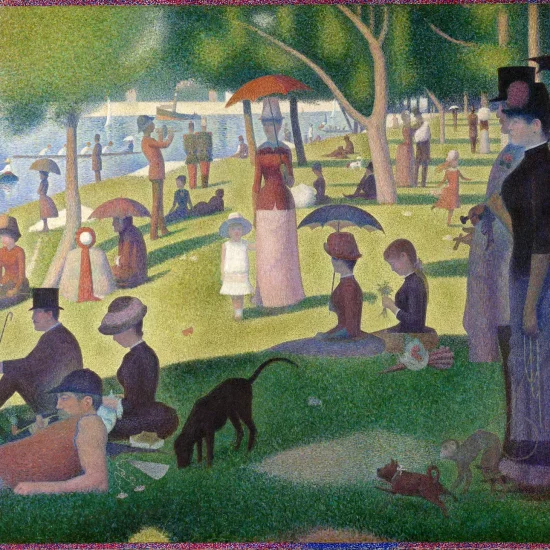
Pointillism, a fascinating technique that emerged in the late 19th century, is all about the power of tiny dots. Instead of using broad brushstrokes to blend colors directly on the canvas, pointillist artists rely on small, distinct dots of pure color. When you stand back from the painting, these dots interact to create an image, almost like magic. It’s like a puzzle where the pieces don’t make sense until you see the bigger picture.
The Birth of Pointillism
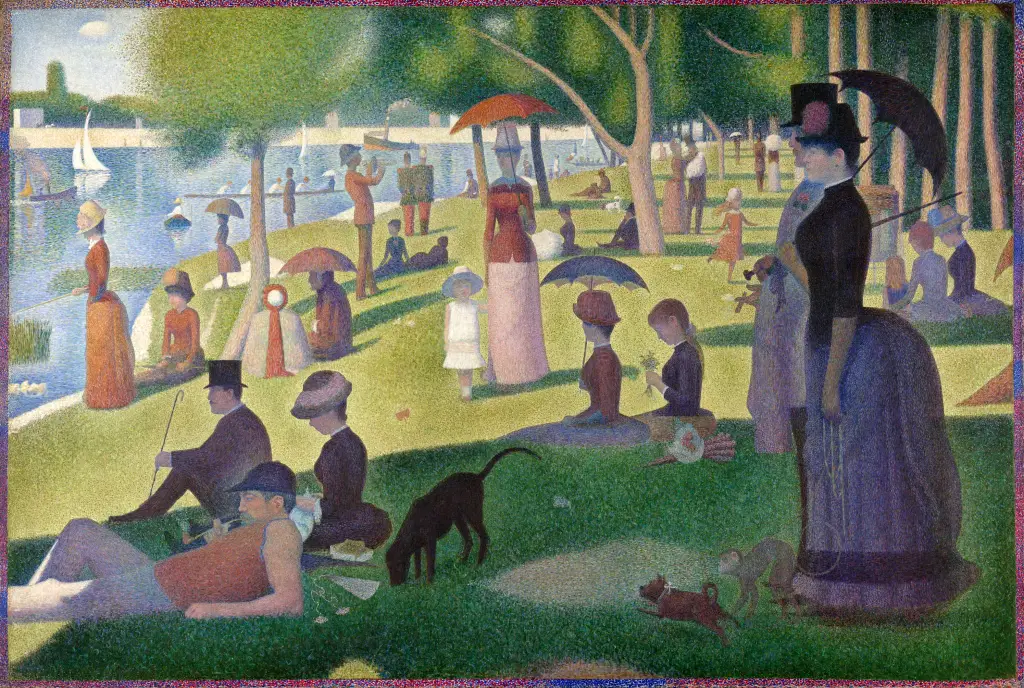
Pointillism was born out of the Neo-Impressionist movement in France. One of its pioneers, Georges Seurat was interested in scientific approaches to color and light. He and his fellow artists wanted to go beyond the spontaneity of Impressionism and bring more structure to their work. Seurat developed this methodical approach in the 1880s, and his most famous piece, A Sunday Afternoon on the Island of La Grande Jatte, is a prime example of pointillism at its best. Imagine an entire painting composed of tiny, meticulous dots, coming together to form a serene scene of people relaxing by the river. The effect is both detailed and surprisingly soft.
The term “pointillism” started as a joke, used by critics to mock the style. But like many names that begin as insults, the artists took ownership of it. And so, what was once a derogatory label became the defining term for a movement.
How Pointillism Works
The technique behind pointillism isn’t just about making dots—it’s about how colors work together. When you paint, you normally mix colors on a palette to get the right shade. In pointillism, artists don’t mix colors directly. Instead, they place dots of pure color next to each other. For example, a patch of green grass might be created by placing tiny dots of blue and yellow side by side. When you look at the painting from a distance, your eyes blend the colors together. It’s an optical illusion that gives the painting a shimmering quality, full of light and movement.
This approach was grounded in scientific theories of color, particularly the work of French chemist Michel Eugène Chevreul. He explored the idea of “simultaneous contrast,” which is the way two colors placed next to each other affect how we perceive them. Pointillist artists were trying to harness these theories to create vibrant, dynamic compositions.
Divisionism vs. Pointillism
Pointillism is sometimes confused with another technique called divisionism. Both involve separating colors, but the difference lies in the brushwork. Divisionism uses larger, more defined brushstrokes, while pointillism sticks to those fine, tiny dots. The two techniques often overlap, and in some discussions, they’re treated almost as synonyms. However, pointillism is more associated with Seurat’s precise method of using dots, while divisionism focuses more on how light is broken down into its component parts.
The Major Artists
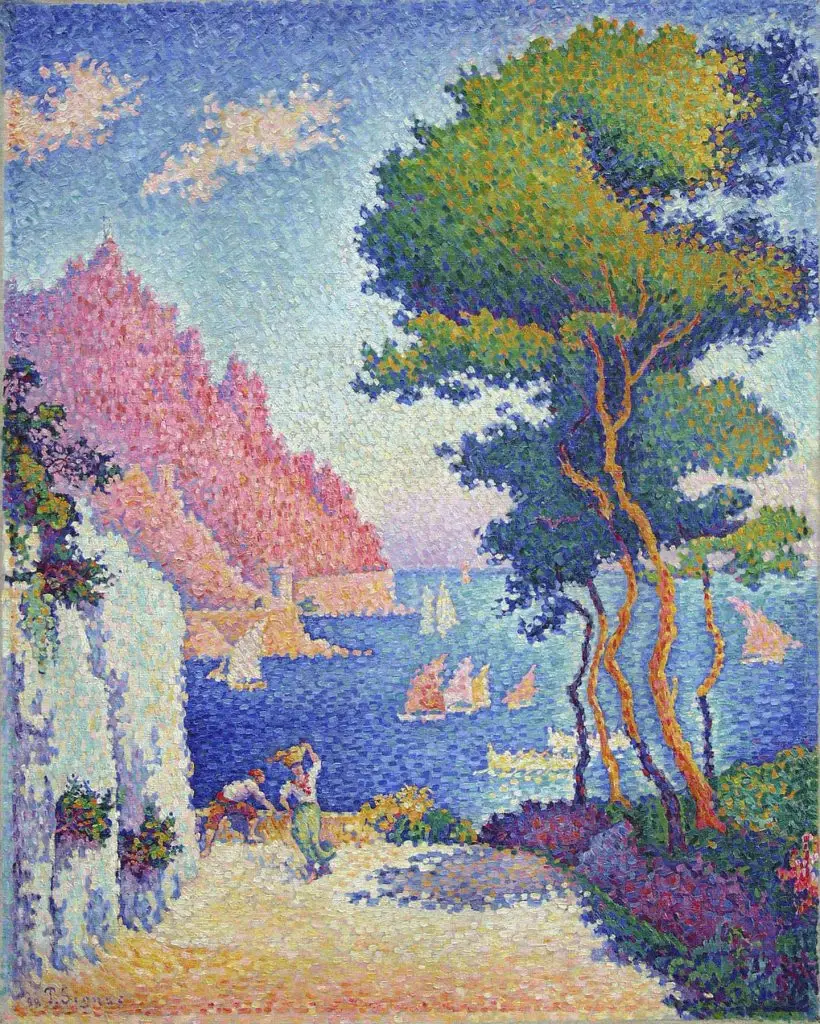
Georges Seurat might be the name most people associate with pointillism, but he wasn’t the only artist working in this style. Paul Signac, another prominent figure, embraced the technique and even took it in new directions after Seurat’s death. While Seurat’s works often have a cool, calculated feel, Signac’s paintings tend to be more colorful and lively. His Capo di Noli is a great example of how pointillism can be used to depict a slice of everyday life.
Camille Pissarro, one of the leaders of the Impressionist movement, also dabbled in pointillism after meeting Seurat and Signac. Though known for his more traditional Impressionist works, Pissarro’s pointillist pieces, like Hoarfrost, Peasant Girl Making a Fire, show how adaptable the technique was. Even Vincent van Gogh, better known for his swirling, expressive brushstrokes, experimented briefly with pointillism. His Self-Portrait from 1887 shows him applying the technique in a way that’s unmistakably Van Gogh—bold and vibrant, but with the disciplined use of color that pointillism demands.
Why it Mattered
At first glance, pointillism might seem like just a quirky offshoot of Impressionism, but it had a lasting impact. By focusing on the science of how we see color and light, pointillist artists helped push the boundaries of what painting could be. Their work laid the groundwork for later movements like Fauvism, where artists continued to experiment with color in bold, new ways.
Pointillism’s influence can also be seen in modern digital art. The idea of breaking an image down into smaller components isn’t that different from how pixels work in digital displays today. Each pixel is like a little dot of color, and together they form the full picture. So in a way, Seurat and his contemporaries were ahead of their time, working with concepts that are now central to our digital world.
Its Legacy
Although pointillism didn’t last long as a dominant art movement, its influence can still be felt. Today, artists continue to be inspired by the meticulous technique and the vibrant colors of pointillism. Whether it’s in traditional paintings or digital forms, the core idea of creating something larger and more beautiful from tiny, distinct pieces lives on.
Pointillism is more than just a technical exercise. It’s a way of looking at the world differently, seeing the connections between things, and realizing that sometimes, the smallest details can make the biggest impact. The next time you look at a painting—whether it’s a masterpiece by Seurat or something more modern—try getting up close. You might be surprised at what you see.