
Early Days and Artistic Roots
Piet Mondrian, born in Amersfoort, the Netherlands, in 1872, didn’t start with the bold, abstract style he’s now known for. Growing up in a creative household with a father and uncle who were artists, Mondrian had a foundation in art early on. He studied at the Academy of Fine Art in Amsterdam, where his first works were very much inspired by nature and landscapes. Imagine peaceful scenes of Dutch windmills, riverbanks, and trees — these early pieces reflected his love for the outdoors and were painted with a realistic style emphasizing natural beauty. But as his career developed, so did his artistic direction, shifting from this traditional look toward something entirely new.
How Mondrian Shifted His Style Towards Abstraction
In 1911, Mondrian moved to Paris, and his style began changing dramatically under the influence of Cubism, a revolutionary movement led by artists like Picasso and Braque. This time in Paris wasn’t just about mingling with other artists; it was a phase where Mondrian really started to question the role of nature in his work. Instead of painting trees as they appeared, he began reducing their forms, breaking them down into geometric shapes and lines. His painting Gray Tree (1911) is a great example of this transition — you can still recognize it as a tree, but the shapes are starting to get a bit abstracted, hinting at the more radical simplifications to come.
Founding De Stijl and the Pursuit of “Pure Abstraction”
World War I led Mondrian back to the Netherlands, where he connected with other artists exploring new abstract ideas. In 1917, he co-founded the De Stijl movement with Dutch artist Theo van Doesburg. De Stijl, meaning “The Style,” was more than a simple art group. Its goal was to create a universal visual language, focusing on purity and simplicity. Mondrian and van Doesburg advocated for a pared-down style using only straight lines, right angles, and a strict color palette of primary colors — red, blue, yellow — alongside black, white, and gray. Mondrian called this approach “Neoplasticism,” aiming to strip away anything personal or emotional from his work, which he saw as a way to express universal truths.
The Evolution of Mondrian’s Geometric Style
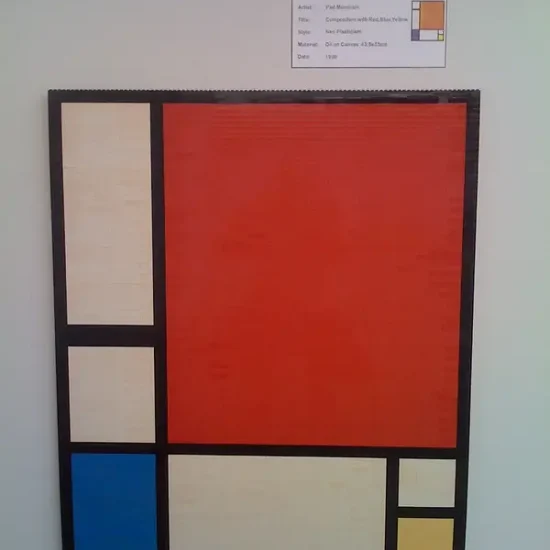
Once World War I ended, Mondrian returned to Paris, where his now-iconic grid paintings began to emerge. These geometric works are deceptively simple, defined by thick black lines that create blocks filled with primary colors or left as empty white spaces. But there’s more than meets the eye. Look closely, and you’ll see Mondrian’s careful brushwork, with each color block painted meticulously, often in a single direction. His compositions from this period, like Composition II in Red, Blue, and Yellow (1930), were both orderly and surprisingly energetic, seeming to pulse with a kind of hidden rhythm despite their simplicity.

Source: Kent Wang, Mondrian building, Attribution-ShareAlike (CC BY-SA 2.0), https://flic.kr/p/AxwdK
The New York Period and “Broadway Boogie Woogie”
In 1938, with World War II on the horizon, Mondrian left Europe for New York City, a move that had a profound impact on his work. The energy of New York and its vibrant jazz scene inspired a fresh style, adding new life to his compositions. His piece Broadway Boogie Woogie (1942-1943) captures the city’s dynamism, buzzing with small, colorful squares in place of the traditional lines, echoing the bustling grid of New York streets and the lively beats of boogie-woogie music. It’s one of his most famous works and a distinct departure from the more restrained grids of his Paris years.
The Legacy Left by Mondrian
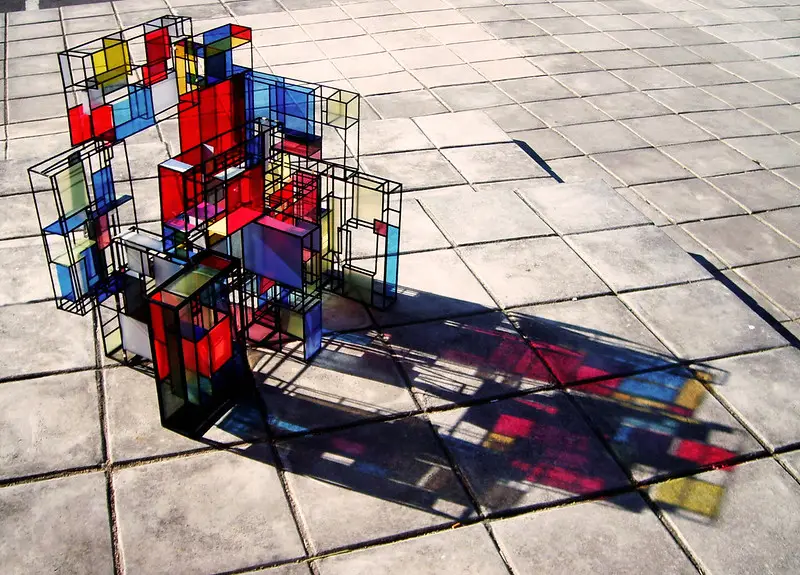
Mondrian’s work went on to influence not only painting but also architecture, graphic design, and even fashion. His clean lines and primary colors resonated with modernist architects like Mies van der Rohe, and you can see hints of Mondrian’s style in mid-century design and beyond. His influence reached pop culture as well, inspiring everything from Yves Saint Laurent’s famous “Mondrian” dress to album covers and interior designs. His legacy is still alive in minimalist aesthetics, with designers and artists often returning to his principles of balance, simplicity, and harmony.
Source: Pip Pilgrim, Mondrian 3D, Attribution (CC BY 2.0), https://flic.kr/p/3kUAAx
Final Words about Mondrian
Piet Mondrian’s art may look simple, but it’s grounded in a philosophy of universal harmony and balance that continues to resonate. His paintings aren’t just abstract; they’re about distilling reality into its most fundamental elements. By reducing everything to a few colors and lines, Mondrian invites us to focus on the basics — not just in art but in life itself. This quest for simplicity in a complex world feels as relevant today as it did during his lifetime, making Mondrian’s work a lasting part of modern culture.
Featured image: Ryan Ruppe, Lego Mondrian – Attribution (CC BY 2.0), https://flic.kr/p/59G1Bn