
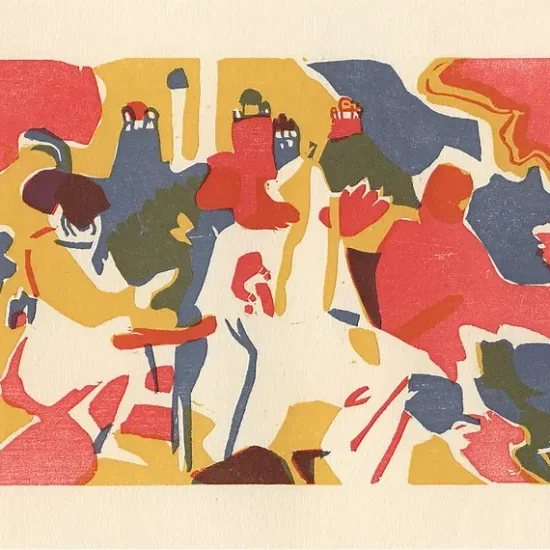
Wassily Kandinsky is widely recognized for his role in establishing abstract art, a movement that revolutionized how we think about creativity and expression. Born in Moscow in 1866, Kandinsky initially studied law and economics but found himself increasingly drawn to art. An encounter with Claude Monet’s work was pivotal, making him realize that colors and forms alone could evoke strong feelings. This idea became central to his career, driving him to Munich to study art formally and eventually to challenge traditional views on painting.
Breaking from Tradition
Kandinsky’s early works show his gradual shift from recognizable subjects to more abstract compositions. Unlike many artists of his time who depicted landscapes or people in realistic detail, Kandinsky saw potential in focusing on color, shape, and line independently. This approach was revolutionary; he believed art could connect with viewers on a deeper level, without the need for a clear subject. In 1911, he published Concerning the Spiritual in Art, a book outlining his belief that art should convey emotions directly. He argued that colors had unique emotional impacts—blue could feel calming, while yellow might seem intense or lively. For Kandinsky, these elements could communicate ideas and emotions beyond words.
The Blue Rider and a New Artistic Direction
In Munich, Kandinsky became part of the art group Der Blaue Reiter (The Blue Rider), along with artists like Franz Marc. Formed around 1911, the group explored new ways of expressing spirituality in art, free from strict rules. Though loosely organized, they shared a commitment to innovation, rejecting art as simply a reflection of the physical world. This shift was especially notable in Kandinsky’s painting Composition V, often cited as one of the first completely abstract works. Through this piece, Kandinsky broke new ground, using form and color to create a feeling rather than depict a specific scene.
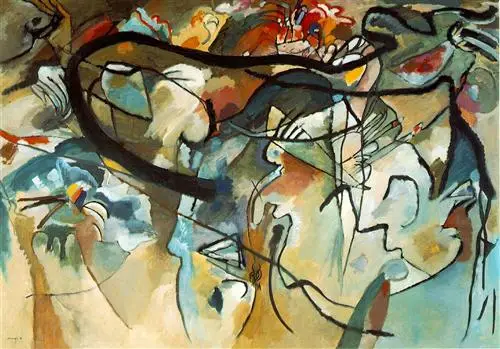
Source: https://upload.wikimedia.org/wikipedia/commons/4/47/Wassily_Kandinsky%2C_Komposition_V%2C_1911.jpg
The outbreak of World War I brought an end to Der Blaue Reiter, with Kandinsky returning to Russia. While back in Moscow, he became involved in establishing new cultural institutions, but he found the country’s emphasis on practical art limiting. He soon moved back to Germany, where he joined the Bauhaus school.
Wassily Kandinsky at the Bauhaus
The Bauhaus was an influential art and design school that focused on integrating fine and applied arts, promoting creativity in everyday life. Kandinsky’s teaching at the Bauhaus allowed him to refine his ideas further, especially around the psychology of shapes and colors. His work at the time took on a more geometric quality, using circles, triangles, and squares in balanced compositions. He was not just creating art but also developing theories about how visual elements affect human emotions. However, as the Nazi regime rose to power, the Bauhaus was forced to close, and Kandinsky’s work was labeled as “degenerate art.” He left Germany and settled in France, where he continued his artistic journey.
Evolving Art and Style
Throughout his career, Kandinsky’s work evolved. His early paintings contain elements of symbolism and expressionism, often showing landscapes or figures. But as he progressed, he shifted entirely to abstract compositions, where shapes and colors alone drove the meaning. Pieces like Yellow-Red-Blue illustrate this later style, where organic, flowing forms mix with geometric patterns to create a sense of movement and depth. In his later works, Kandinsky began incorporating biomorphic shapes—forms that seem alive or inspired by nature but aren’t easily identifiable. His exploration of these forms allowed viewers to interpret his paintings personally, finding their own meanings in the interplay of colors and shapes.
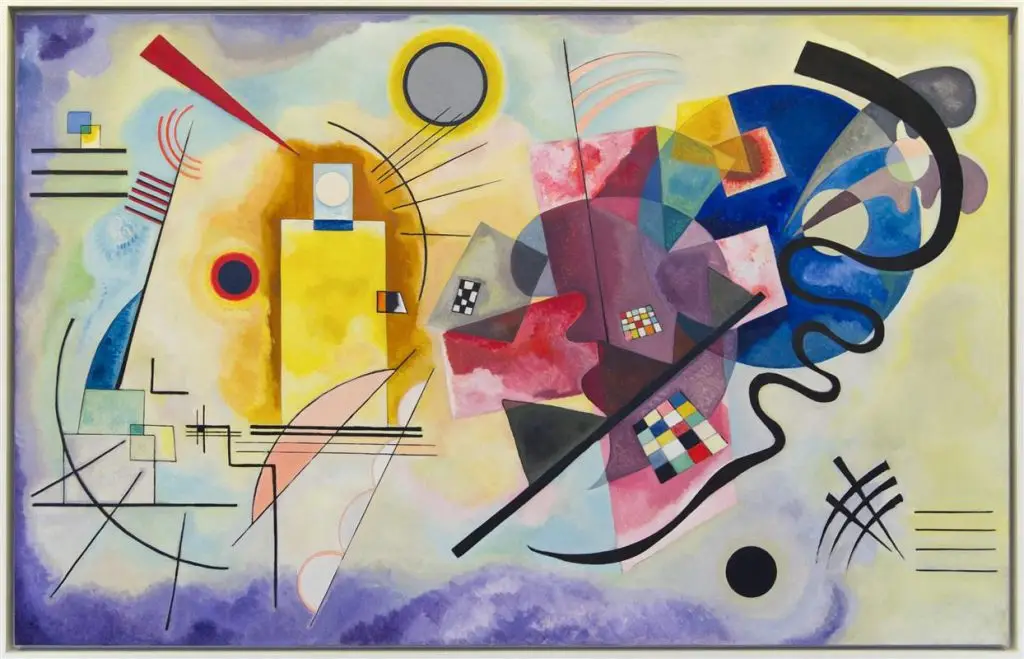
Source: https://www.wikiart.org/en/wassily-kandinsky/yellow-red-blue-1925
The Legacy Left By Wassily Kandinsky
Kandinsky’s influence on modern art is enormous. By focusing on abstraction, he opened doors for future artists to experiment with form and color. His ideas inspired countless movements, from abstract expressionism to modern design. Artists like Jackson Pollock and Mark Rothko, who also sought to express deep emotion without clear subjects, were greatly influenced by his theories. Kandinsky’s work challenged the conventional view that art should be easily understood or realistically depict the world. Instead, he showed that art could be an experience, a moment of connection between artist and viewer that doesn’t rely on words or familiar scenes.
In his journey from Moscow to Munich, the Bauhaus, and eventually France, Kandinsky reshaped art’s boundaries. His career spanned periods of political upheaval and cultural shifts, but his dedication to exploring what art could be never wavered. Today, Kandinsky’s work invites us to see painting in a new way, where colors and forms create a language of their own, one that speaks to us directly without the need for translation.
Featured image: Gandalf’s Gallery, Wassily Kandinsky – Orientallsches, Attribution-ShareAlike (CC-SA BY 2.0), https://flic.kr/p/8crKnC