
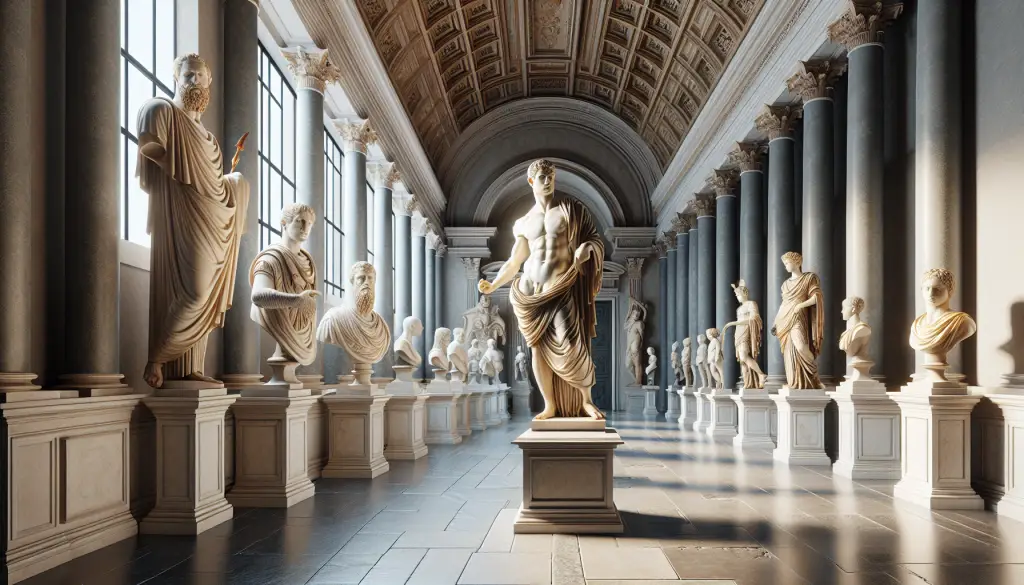
Introduction to Roman Statues and the Human Form
Roman statues occupy an exalted place in the history of art, serving as windows into the lives, beliefs, and aspirations of an empire that spanned centuries. These works of art were not merely decorative but profoundly significant to Roman culture and identity.
Ancient Rome inherited much from earlier civilizations, with Greek traditions in sculpture playing an especially pivotal role. Over time, however, Roman artists carved out their own unique identity. The human form became a central subject of expression, reflecting both the realism of everyday life and the idealism of divine perfection.
In Roman sculptures, two dominant artistic approaches emerged—realism and idealism. Realism sought to capture the gritty details of humanity, while idealism offered an idealized, often divine vision of human beauty. This article explores how these two styles interacted in Roman statues, creating a uniquely Roman artistic narrative that continues to resonate today.
The Historical Significance of Roman Statues
Roman statues were much more than decorative—they were vessels for memory, intended to commemorate historical figures and glorify accomplishments. Political leaders like emperors and military generals were immortalized in marble and bronze, their likenesses capturing not just their physical features but also their perceived virtues and power.
Beyond individuals, Roman statues reflected societal values, religious beliefs, and cultural identity. They adorned civic spaces, temples, and forums, functioning as propaganda tools and spiritual symbols. Public art in Rome served to educate citizens and reinforce shared values, creating a visual narrative that united a diverse empire.
Statues also celebrated deities and mythological figures, offering Romans a way to connect with their gods and express collective aspirations. Through their sculptures, Romans perpetuated their history and identity for generations to come—a legacy visible even today. The survival of so many statues underscores their enduring importance.
Pro Tip: Next time you visit a Roman statue in a museum, examine the inscriptions—many carry intriguing details about who commissioned them and why!
Realism in Roman Sculpture
One hallmark of Roman art was its embrace of realism, particularly in portraiture. Busts of public figures showcased intricate details, from wrinkles and scars to the contours of muscles and veins. This style, known as verism, emphasized authenticity, sometimes to the point of hyper-realism.
Verism wasn’t merely an exercise in artistic skill; it was a statement. By portraying age, imperfections, and individuality, Roman sculptures conveyed wisdom, experience, and strength, reflecting the Roman respect for hard-won achievement and life’s challenges.
Statues such as the busts of Cicero and Cato stand as masterpieces of verism. These works didn’t just mimic reality—they glorified it. Realism allowed common citizens to relate to their leaders and ensured that the accomplishments of individuals were eternally remembered.
Pro Tip: Notice how the texture of skin and hair is rendered in Roman sculptures. These details demonstrate the extraordinary craftsmanship of Roman sculptors.
Idealism in Roman Statues
While realism captured human imperfection, idealism reflected aspiration. Inspired by Greek traditions, Roman artists embraced idealism to portray divine beauty and strength. This approach was often used in depictions of gods, mythological heroes, and even emperors.
Idealistic statues elevated their subjects to godlike status, presenting them as paragons of virtue, fitness, and nobility. These sculptures aimed to inspire awe and reverence. For example, the Augustus of Prima Porta depicts the emperor with a flawless physique, symbolizing his authority and divine favor.
Idealism allowed artists to go beyond the bounds of reality and imagine humanity at its best. It served as a counterbalance to realism, showing what Romans aspired to rather than what they were.
Pro Tip: Look for mythological symbols or gestures in idealized statues—they often have hidden meanings related to the subject’s story or character.
The Blending of Realism and Idealism
Roman art is renowned for its ingenious blending of realism and idealism. Many statues skillfully combined the lifelike features of realism with the flawless beauty of idealism, creating a dual narrative that was both authentic and aspirational.
This synthesis served various purposes. Politically, it allowed emperors and leaders to appear relatable yet superior. Culturally, it honored human achievement while reaching toward divine perfection. A notable example is the statue of Emperor Marcus Aurelius, which balances realistic facial details with an imposing, idealized posture.
This blending of styles was a truly Roman innovation, showcasing their ability to adapt traditions to their needs. It also made their art uniquely timeless and influential.
Pro Tip: When analyzing a Roman statue, consider how its proportions, posture, and expression reflect a mix of realism and idealism.
The Role of Material and Technique in Roman Sculpture
Roman sculptures were crafted using a variety of materials, primarily marble, bronze, and stone. Marble was favored for its durability and ability to capture fine details, while bronze allowed for dynamic and intricate compositions. Stone, though less common for statues, was used for large-scale works.
Techniques like chiseling and casting enabled Roman artists to achieve remarkable precision in both realistic and idealized forms. Additionally, many statues were originally painted, adding lifelike color and vibrancy to their creations. Unfortunately, most paint has faded with time, but traces remain.
With their expertise in material and technique, Roman sculptors pushed the boundaries of what was artistically possible, leaving behind works that have stood the test of time.
Pro Tip: Keep an eye out for traces of paint or metal detailing on ancient statues—they hint at how colorful these pieces once were.
The Legacy of Roman Statues in Art History
Roman statues have had a profound impact on art history, influencing the Renaissance and continuing to inspire modern artists. The rediscovery of Roman art during the Renaissance sparked a renewed appreciation for classical ideals, leading to masterpieces like Michelangelo’s David.
Today, Roman statues remain a source of fascination, offering insights into history, culture, and human creativity. Museums worldwide preserve these treasures, enabling us to learn about the Roman Empire and our shared artistic heritage.
Roman statues remind us of humanity’s enduring fascination with the human form and our capacity to convey complex ideas through art.
Pro Tip: Many museums offer virtual tours of Roman art collections, making it easier to explore these masterpieces from anywhere!
Conclusion: Realism, Idealism, and the Timeless Appeal of Roman Sculpture
The interplay between realism and idealism in Roman statues continues to captivate us. Through these artistic approaches, Rome celebrated both the imperfections of humanity and the aspirations of divinity.
Roman statues stand as cultural achievements, bridging the past and the present. They teach us about human expression, societal values, and artistic ingenuity. Their legacy endures not just in art history but also in our collective imagination.
In the end, Roman statues affirm a timeless truth: the human form, whether imperfect or idealized, remains one of the most profound vehicles of artistic expression.