
Who Is Banksy?
Banksy is a British street artist whose name alone sparks mystery and intrigue. Known for his undiscovered identity and satirical stencils, Banksy’s work has become instantly recognizable, even for those who don’t follow the art world. Working primarily in public spaces, he uses walls, buildings, and sidewalks as his canvas, layering irony and dark humor over social commentary. His style mixes graffiti with a sharp, provocative edge, making his art feel like both a protest and a punchline.
Making a Statement Without a Signature
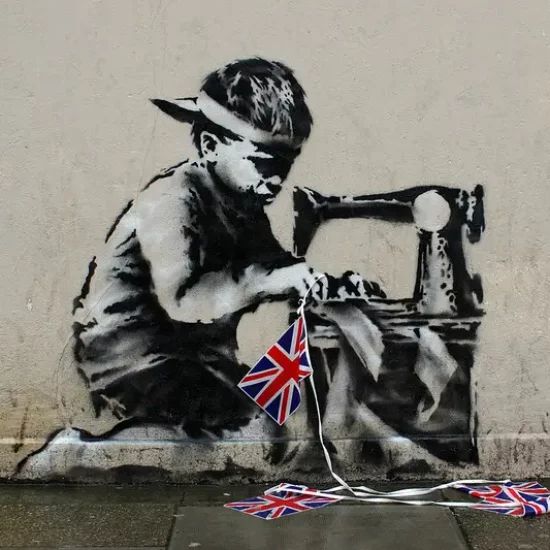
Banksy’s art rarely comes with a signature or even an overt message, but you don’t have to look long to see what he’s getting at. Whether he’s taking on consumerism, war, government surveillance, or even art itself, his work doesn’t just sit in galleries. It’s out in the world, where people stumble across it unexpectedly, inviting them to think twice about what they’re looking at. Take his piece “Slave Labour,” painted on the side of a Poundland store in London. It shows a young boy sewing Union Jack bunting, nodding to child labor exploitation. When this work was removed from the wall and put up for auction, it stirred a debate about who art really belonged to: the people or the market?
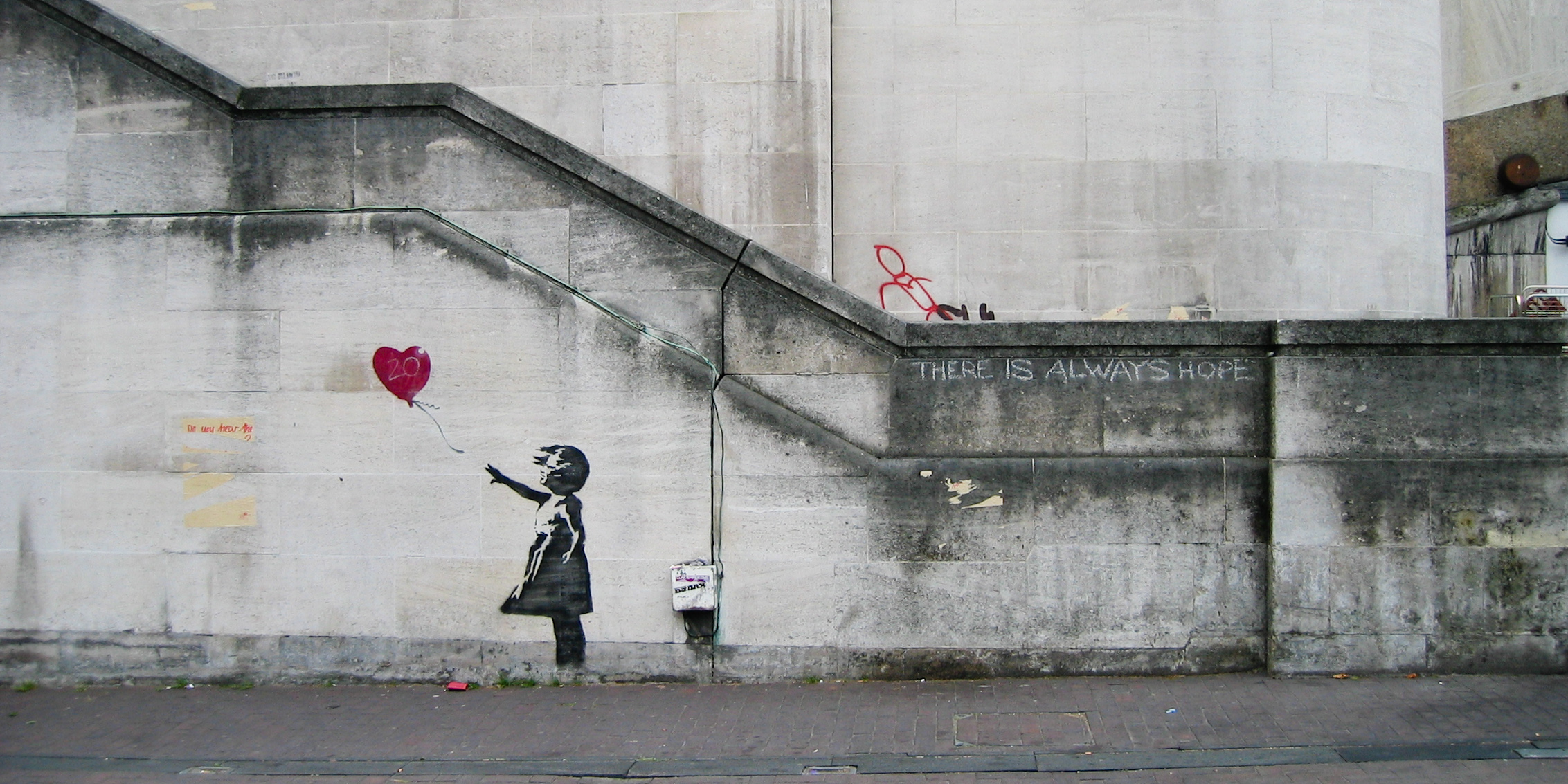
Another classic example is “Girl with Balloon,” a simple yet moving stencil of a young girl releasing a heart-shaped balloon. While the piece may seem straightforward, people interpret it as a commentary on loss, hope, or innocence. The twist came when the piece self-destructed after selling at auction, shredding itself as soon as the gavel dropped. It’s like Banksy reminded us that his work is temporary and, above all, not meant for easy commercialization.
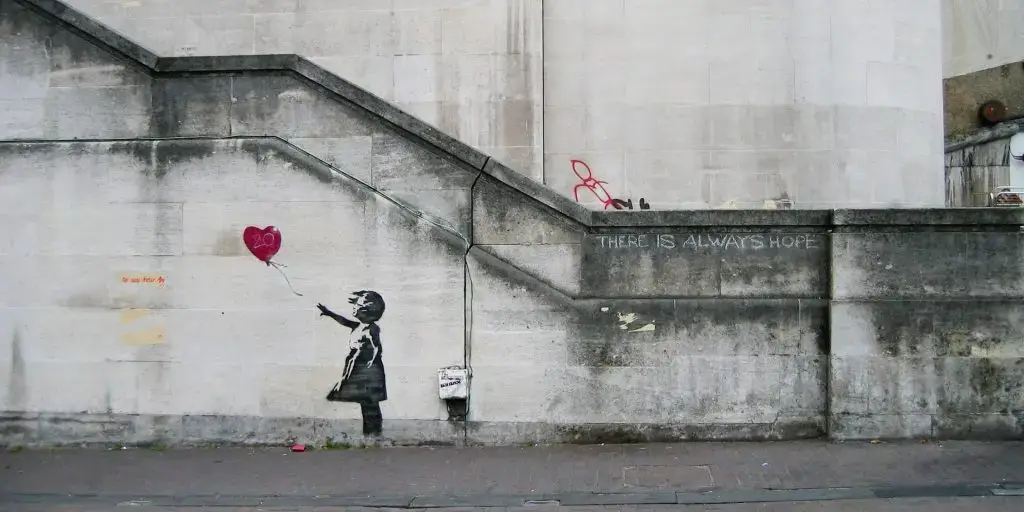
Source: Banksy – Girl with Balloon Attribution-ShareAlike (CC BY-SA 2.0), Wikimedia
The Characteristics of Banksy’s Art
Banksy’s technique revolves around stenciling, which gives his work its clean, striking lines and iconic look. But it’s more than just a practical choice; the speed of stenciling also helps him maintain his anonymity, as it allows him to quickly apply his designs and slip away before anyone realizes what’s happening. This rapid process has helped him produce pieces in cities worldwide, from London and New York to the West Bank barrier, where his work provides social commentary on conflicts like the Israeli-Palestinian divide. His “Balloon Debate” mural on the barrier wall showcases a girl floating away on balloons, which evokes a sense of innocence contrasted with the stark reality of the wall itself.

Source: Banksy – Flying Balloon Girl, also known as Balloon Debate, Attribution (CC BY 2.0), Wikimedia

Banksy on Film: Exit Through the Gift Shop
In 2010, Banksy released a documentary called Exit Through the Gift Shop. The film follows Thierry Guetta, a French filmmaker and street art enthusiast who ends up creating his own art under the name “Mr. Brainwash.” But in classic Banksy style, the documentary blurs the line between truth and fiction, leaving audiences guessing if the film was a genuine look at the art world or another one of Banksy’s social experiments. Despite (or because of) this ambiguity, the documentary became a hit, receiving critical acclaim and even an Oscar nomination. For Banksy, this film was another way to explore his recurring themes of authenticity and the commercialization of art.
Banksy’s View on the Art Market
Banksy’s stance on the art market is as unconventional as his art. He’s known for questioning the way society values art, particularly when it’s sold for huge sums of money. His shredded “Girl with Balloon” stunt was a statement on art’s transitory nature and a jab at the inflated prices of his works. Banksy has even called for people to avoid buying street art that wasn’t intended for sale, arguing that these pieces lose their meaning when they’re taken out of their context.
He’s also shown disdain for auction houses selling his works that were originally painted in public spaces. In one instance, when his “Slave Labour” piece was removed from a wall in London and shipped overseas for auction, the move sparked public outrage. It highlighted how the art market can remove art from its community, transforming it into an expensive collectible instead of something that anyone can experience for free.
The Banksy Effect: Changing the Conversation Around Street Art
Banksy’s impact on the art world has been monumental, helping to legitimize street art in the eyes of many who once saw it as nothing more than vandalism. His rise in popularity has brought street art into the mainstream, showing that graffiti can carry powerful messages and even make it into galleries. But despite his fame, Banksy’s work retains a sense of mystery and rebellion, refusing to conform to the rules of traditional art spaces. His work encourages viewers to ask questions, challenge norms, and rethink what art can be.
Banksy’s influence can be seen in the way other artists have approached public spaces and social issues. By breaking down the barriers between “high” and “low” art, he’s helped to pave the way for other artists to experiment, allowing street art to become part of the broader cultural conversation. His use of humor, irony, and dark wit keeps his messages accessible, ensuring that his work resonates with a wide audience.
Banksy’s Art and the Future
Banksy’s art may be here today and gone tomorrow, but his legacy is hard to ignore. His work has inspired countless artists, challenged traditional notions of art ownership, and pushed conversations about social issues into the spotlight. Banksy’s anonymity only amplifies his mystique, allowing his art to speak for itself without the influence of his identity. He’s proven that sometimes, art doesn’t need a name attached to make a lasting impact. In a world that seems to always be asking for more information, Banksy is a reminder that sometimes mystery is more powerful than clarity.
So whether you view Banksy as a prankster, a genius, or just someone with a knack for creating buzz, one thing’s clear: his art makes people think. And in a world where art can feel increasingly out of reach, Banksy keeps it grounded, accessible, and refreshingly disruptive.
Featured image: Photo by DeptfordJon, Artist: Banksy – Slave Labour, Attribution (CC BY 2.0) – https://flic.kr/p/bYH7VN