
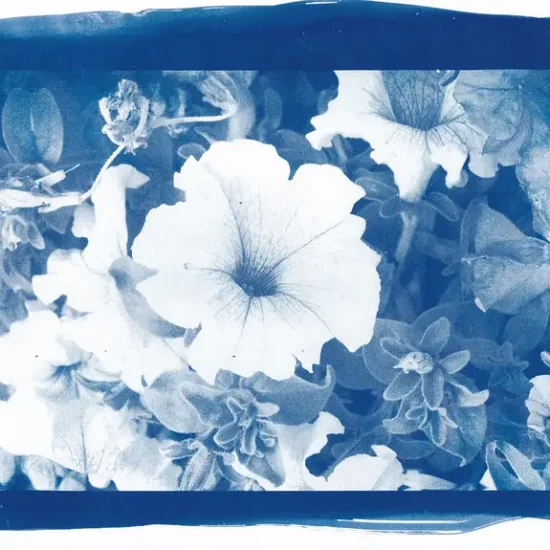
Cyanotype is a historic photographic process that’s come back into style in recent years, beloved for its rich blue tones and simplicity. Originally developed in the 19th century, it’s now used by artists and hobbyists alike who are drawn to its unique aesthetic and easy, accessible process. Let’s dive into how it all started, how the technique works, and why people still love making cyanotypes today.
The Origins of Cyanotype
In 1842, Sir John Herschel, an astronomer and scientist, discovered the cyanotype process while exploring ways to make blueprints. His work with light-sensitive iron salts created an affordable, stable way to produce images, resulting in prints that turn a striking blue color—thanks to the compound known as Prussian blue. Although Herschel invented cyanotypes for scientific use, his discovery soon captured the attention of artists. English botanist Anna Atkins, for instance, famously used cyanotypes to document algae and other plants, creating the first-ever photographic book. Her prints not only served as scientific illustrations but became artworks in their own right. Cyanotypes gradually gained popularity and were even used for practical purposes like making architectural blueprints, as they were cost-effective and didn’t fade easily.
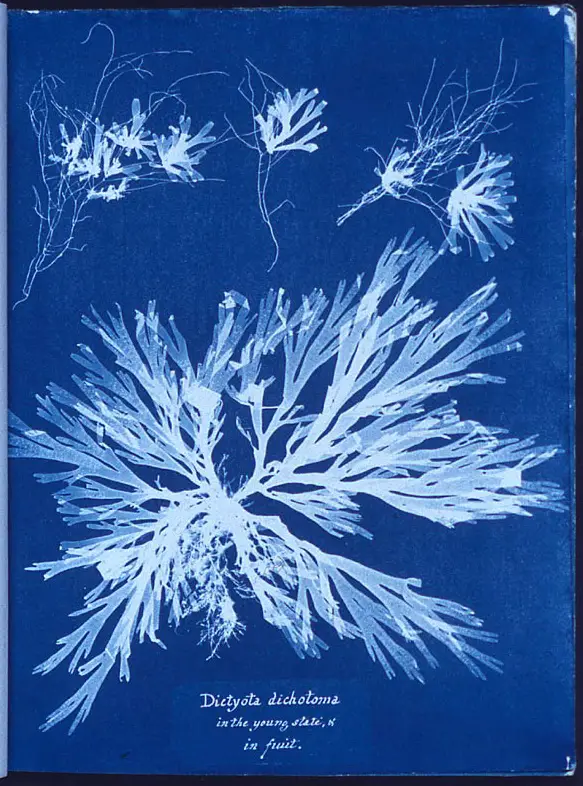
Source: https://upload.wikimedia.org/wikipedia/commons/c/c4/Anna_Atkins_algae_cyanotype.jpg
The Cyanotype Process
The beauty of cyanotype is in its simplicity. It uses just two chemicals: ferric ammonium citrate and potassium ferricyanide. These are mixed and then brushed onto a surface—typically paper or fabric. Once dried, the coated surface becomes photosensitive. To create an image, an object or a negative is placed on the treated surface, which is then exposed to UV light, usually sunlight. The areas exposed to light turn blue, while the parts covered by the object or negative remain a lighter shade. After exposure, the print is rinsed in water, washing away unexposed chemicals, and the iconic blue image starts to emerge. As the print dries, it deepens into a darker, richer blue.
One of the most appealing things about cyanotypes is that you don’t need any fancy equipment. All you need is sunlight, water, and some basic materials, which has kept it popular among both professional artists and beginners looking to experiment with photography.
Cyanotypes Through the Years
While cyanotypes were initially popular in the 19th century, they lost some of their appeal as more advanced photographic techniques emerged. However, the ease and low cost kept them alive, especially in practical fields like architecture and engineering, where blueprints were a staple for over a century. The process didn’t completely disappear from the art world, though. A few photographers and artists continued to use cyanotypes throughout the 20th century, valuing its distinctive color and handmade quality. In recent years, the process has had a resurgence, especially among artists who appreciate the organic feel and vibrant color of cyanotypes. Contemporary photographers like Kate Cordsen and Meghann Riepenhoff use cyanotypes to create experimental, dreamlike images, keeping the art form alive and adding their own creative twists.
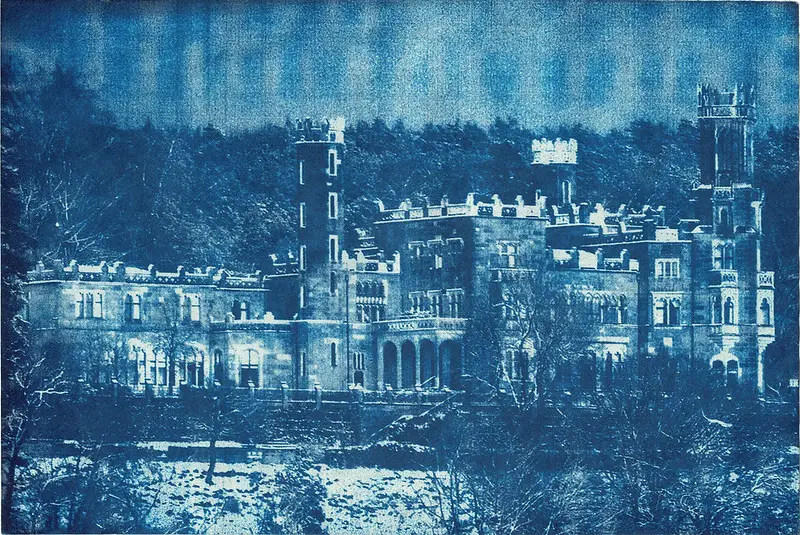
Source: Bernd Hutschenreuther, Schloss Eckberg, Dresden, Attribution-ShareAlike (CC BY-SA 2.0), https://flic.kr/p/WmfXcE
Making Cyanotypes Today
What’s great about cyanotypes is how approachable they are. Many artists and hobbyists make cyanotypes at home using either their own mixed chemicals or pre-made kits. You don’t need a darkroom, either—just enough sunlight for exposure and water to rinse the print. Because the chemicals are applied manually, each print has slight variations, giving it a unique, one-of-a-kind look. Some people like to experiment with different surfaces, using everything from traditional watercolor paper to fabrics and wood, which can lead to all kinds of creative results. There are even digital twists, where artists use digital negatives to print on transparency film, allowing them to reproduce photos in the cyanotype process.
If you’re interested in trying it yourself, you can easily find cyanotype kits online. These kits come with pre-sensitized paper or fabric, so all you need to do is find an object or image to print, expose it to sunlight, and rinse to reveal the image.
The Allure of Cyanotypes
Cyanotypes aren’t just about the deep blue color—though it’s a huge part of their charm. They’re about creating something tangible in a world where most of our images live on screens. Each cyanotype is a bit of an experiment, a mix of science and art where the results can vary depending on sunlight, exposure time, and even the weather. This unpredictability, combined with the iconic blue hue, has made cyanotypes a favorite for artists and photographers looking to explore beyond the digital realm. The process invites people to slow down, to appreciate the natural world, and to find beauty in simplicity. And while cyanotypes may be over a century old, they’re still inspiring artists and photographers, proving that sometimes, the simplest processes leave the most lasting impressions.
Featured image: Bernd Hutschenreuther, Cyanotypie Petunie, Attribution-ShareAlike (CC BY-SA 2.0), https://flic.kr/p/2oHGWri