
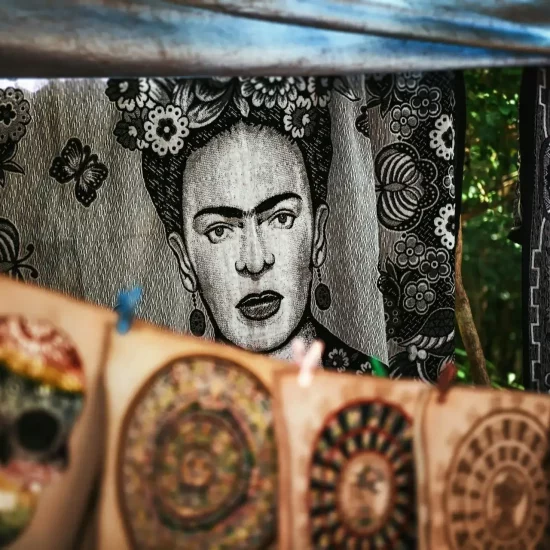
Introduction to Frida Kahlo’s Paintings
Frida Kahlo’s paintings stand out not just for their vivid colors or symbolic imagery, but for the deeply personal stories it tells. Each of them acts as a window into her life, reflecting physical pain, emotional struggle, and her Mexican identity. Kahlo’s works are often categorized as surrealist, but she rejected this label, claiming that her paintings were a reflection of her reality rather than dreams or fantasies. This article explores some of her most significant paintings, which capture the complexity of her emotions and experiences.
The Most Famous of Frida Kahlo’s Paintings: The Two Fridas (1939)
One of Frida Kahlo’s most iconic paintings, The Two Fridas, is a double self-portrait that depicts two versions of herself. On one side, Kahlo is dressed in a traditional Tehuana dress, while on the other, she appears in a European-style gown. This painting was completed during her separation from Diego Rivera, her husband and fellow artist, and it powerfully represents her emotional turmoil.
In the portrait, the heart of the European-dressed Frida is broken and bleeding, with an artery cut and disconnected, while the artery of the traditionally dressed Frida remains intact, symbolically connected to a small portrait of Rivera. The stormy background and exposed hearts emphasize her physical and emotional pain. The Two Fridas represents the internal conflict between her two identities: her Mexican roots and her experiences influenced by European culture. It also reflects her struggles with self-acceptance and love.
What the Water Gave Me (1938)
Source: https://upload.wikimedia.org/wikipedia/en/e/e4/What_the_Water_Gave_Me_by_Frida_Kahlo.jpg
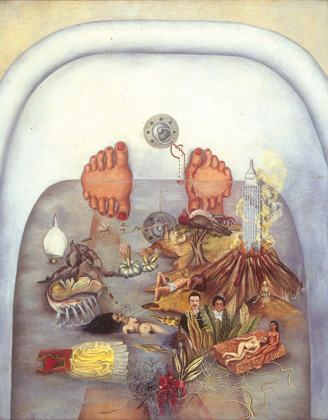
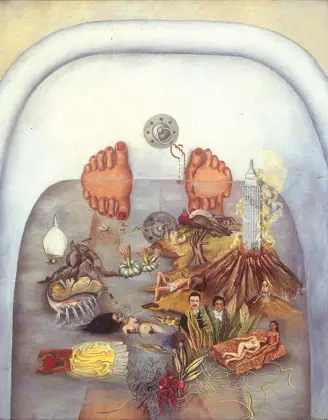
This lesser-known but highly symbolic painting gives viewers a unique perspective—Kahlo’s legs and feet are visible from her viewpoint, submerged in a bathtub. Within the water, surreal and symbolic images float, including a skeleton, a dead bird, a woman drowning, and a crumbling skyscraper. These objects represent both personal memories and broader emotional states, intertwining life and death, hope and despair. The central motif of water suggests an overwhelming sense of drowning, symbolizing her psychological and physical struggles.
Kahlo once described the painting as capturing her thoughts and memories, a visual representation of her mind’s inner workings. Its dreamlike quality led to its association with surrealism, though Kahlo insisted it was simply a reflection of her lived reality.
Self-Portrait with Cropped Hair (1940)
Source: https://flic.kr/p/24rm7VZ
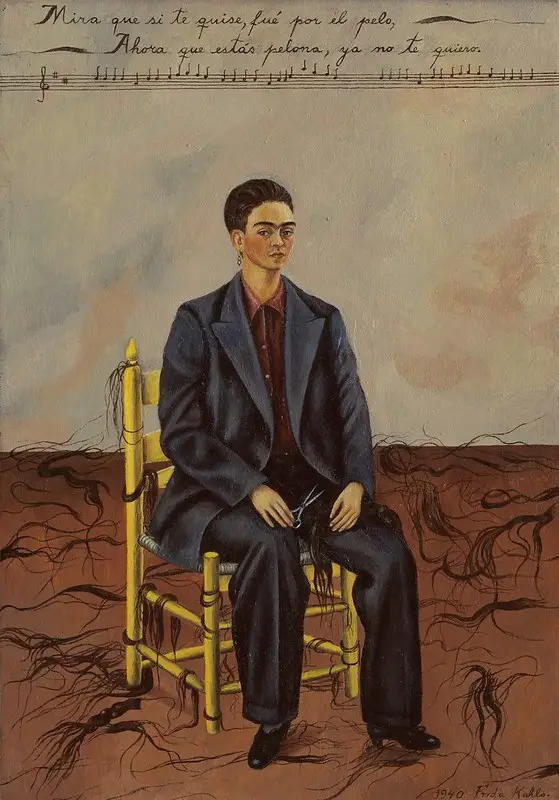
In this bold self-portrait, Kahlo confronts traditional gender roles and her personal feelings of betrayal following her divorce from Rivera. The painting depicts her seated in a chair, wearing a suit, her once iconic long hair cut off and scattered around her. The contrast between her masculine attire and her feminine features challenges the viewer’s assumptions about identity and gender.
By cutting her hair, Kahlo symbolically rejects her previous self, perhaps even her femininity, as a response to her failed marriage. The painting’s inscription, which reads “Look, if I loved you, it was for your hair. Now you’re bald, I don’t love you anymore,” adds another layer of emotional complexity, suggesting both defiance and vulnerability.
The Wounded Deer (1946)
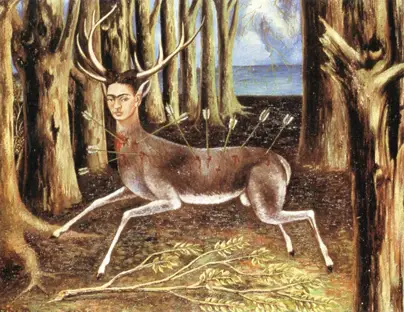
Source: https://upload.wikimedia.org/wikipedia/en/9/92/The_Wounded_Deer_1946.jpg

In The Wounded Deer, Kahlo’s face is superimposed on the body of a deer, which is pierced with arrows. The wounded animal stumbles through a dark forest, representing Kahlo’s own physical suffering. Kahlo had undergone multiple surgeries to alleviate her chronic pain, but none were successful, and this painting reflects her growing sense of hopelessness.
The nine arrows piercing the deer symbolize both her physical pain and emotional despair. The expression on the deer’s face, one of calm amidst agony, speaks to her resilience despite constant suffering. It’s a poignant metaphor for her body, which failed her time and time again.
Henry Ford Hospital (1932)
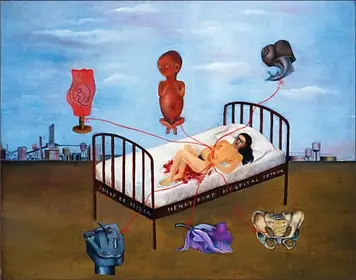
Source: https://upload.wikimedia.org/wikipedia/en/d/d9/Frida_Kahlo_painting_Henry_Ford_Hospital_1932.jpeg

This painting is among Kahlo’s most heartbreaking, capturing a particularly traumatic experience: her miscarriage in Detroit. Kahlo lies on a hospital bed, naked and vulnerable, surrounded by symbols of her suffering. Six red cords, resembling umbilical cords, connect her to various objects, including a fetus, a flower, and a pelvis. These objects represent her lost child, her failed attempts at pregnancy, and her shattered body.
The painting confronts the viewer with the physical and emotional weight of miscarriage, an experience Kahlo struggled with throughout her life. Her portrayal of herself as both victim and witness to her own tragedy highlights her strength in the face of overwhelming grief.
Self-Portrait on the Borderline Between Mexico and the United States (1932)
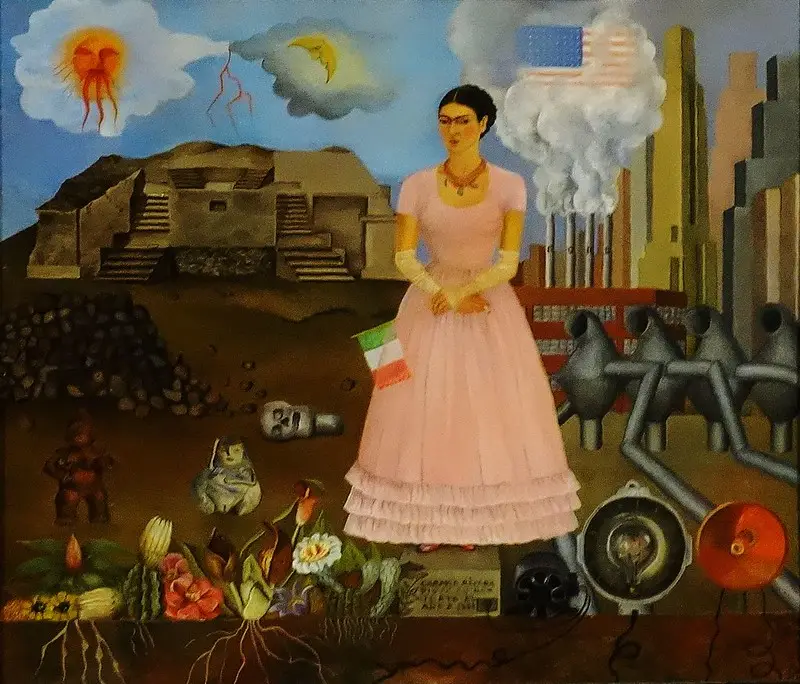
Source: Jens Cederskjold – Frida Kahlo – Self-Portrait on the Borderline between Mexico and the United States Attribution-ShareAlike (CC BY-SA 2.0) – https://flic.kr/p/2jPKoz9
This painting visually expresses Kahlo’s ambivalence towards her time in the U.S. and her deep connection to her Mexican roots. In the painting, Kahlo stands between two contrasting worlds: on one side, the industrialized landscape of the U.S., and on the other, the natural, colorful landscape of Mexico. She holds a small Mexican flag, signaling her allegiance to her homeland.
This work reflects her unease with American culture and her longing for Mexico, as well as the tension she felt between tradition and modernity. The contrast between the two landscapes emphasizes her sense of displacement during her time abroad.
Conclusion: Frida Kahlo’s paintings
Frida Kahlo’s paintings are deeply personal reflections of her life experiences. They explore themes of identity, gender, pain, and Mexican culture. Through her art, Kahlo communicated her physical suffering and emotional resilience, making her one of the most influential artists of the 20th century. Each brushstroke reveals another layer of her story, inviting viewers into her world of contradictions, where beauty coexists with pain, and strength emerges from vulnerability.
Though Kahlo’s life was filled with hardship, her art endures as a powerful testament to her spirit, inspiring generations of artists and admirers alike. Her ability to transform personal pain into universal themes makes her work timeless and endlessly relevant.