The Setting and Inspiration for Guernica
In 1937, during the Spanish Civil War, the small town of Guernica became the target of a devastating airstrike. German and Italian warplanes bombed this village in northern Spain, which held cultural significance for the Basque people. The bombing left the town in ruins and caused widespread suffering among civilians. Reports and images of the attack quickly spread across Europe, causing international shock and anger. Picasso, a Spanish artist living in Paris, was moved deeply by the incident and felt compelled to respond. This became the spark that led him to create Guernica, a powerful anti-war mural.
Originally, Picasso had been commissioned to paint a piece for the Spanish pavilion at the 1937 World’s Fair in Paris. After hearing about the events in Guernica, he abandoned his original idea and began working on a piece that would express the horror of the recent attack. The result was a haunting image that has resonated worldwide.
The Artwork: Black, White, and Powerful
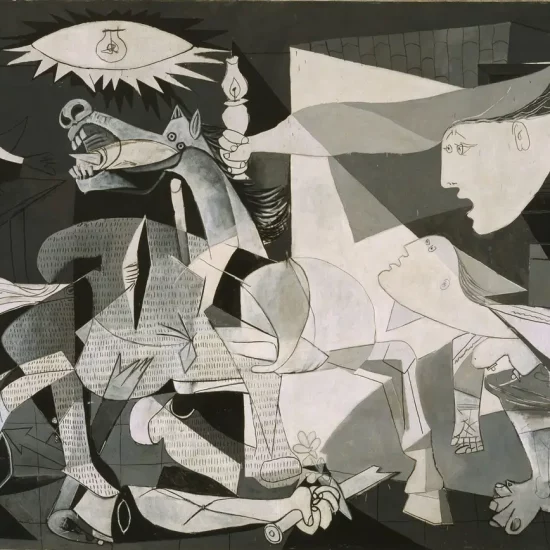
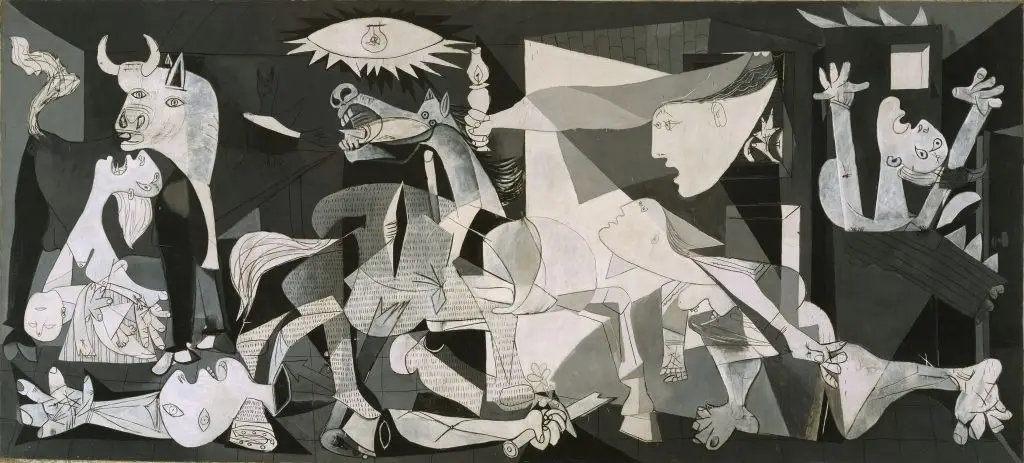
Picasso’s Guernica is huge, measuring roughly 11 feet tall and 25 feet wide. It’s entirely painted in black, white, and shades of gray. This choice adds a stark, newsprint-like feel to the piece, almost as if it’s a visual record pulled from a newspaper. Picasso’s choice to forgo color amplifies the bleakness and raw emotion captured in each brushstroke, emphasizing sorrow and despair rather than distracting with vibrant hues. The overall feel is dark, intense, and sad, much like the event’s impact.
Key Figures and Their Meanings
Guernica is filled with symbolic characters that add layers of meaning to the piece. At the center of the painting is a frantic horse, often interpreted as a representation of the people’s suffering. Some see the horse as a symbol of democracy being crushed under the weight of authoritarian rule. A bull, another prominent figure, stands over the scene, often seen as a symbol of brutality and violence. Picasso had used bulls in his earlier works, usually as emblems of strength, but in this case, the bull seems more menacing, possibly representing the oppressors and fascism itself.
Scattered around the painting are various human figures, each twisted or contorted in anguish. One figure holds a limp child, and another screams toward the heavens. Each figure captures a snapshot of suffering, showing the emotional toll the bombing took on civilians. One notable detail is a broken statue on the ground, thought to symbolize the destruction of culture and tradition in the face of war. The overall composition feels chaotic and fractured, mimicking the disarray caused by the bombing.
Reactions and the Legacy of Guernica
At first, Guernica didn’t receive immediate acclaim. When Picasso unveiled the mural at the Paris Exposition, reactions were mixed. Some viewers were perplexed or even disturbed by the artwork, as it strayed from conventional representations of war scenes. Yet, as news of the bombing continued to circulate, Guernica gained traction as an iconic statement on the horrors of modern warfare. Over time, it became not only a symbol of the Spanish Civil War but also a universal cry against the destruction that war brings.
After its debut, Guernica toured internationally, raising awareness about the Spanish Civil War. It served as a powerful reminder of what had happened in Guernica, spreading its message far beyond the boundaries of Spain. The mural became an iconic anti-war image and has been viewed as a protest against violence everywhere. In a poignant anecdote, a German officer allegedly asked Picasso if he had created the piece, to which Picasso replied, “No, you did.” This response reinforced the idea that Guernica wasn’t just about Spain; it was a message about the senseless violence of war.
The Painting’s Home and Its Lasting Influence
Today, Guernica resides in the Museo Reina Sofía in Madrid, where it continues to captivate viewers. The mural serves as a reminder of the suffering caused by war, urging viewers to reflect on the impact of conflict on ordinary people. Its symbolism and visual language still resonate with modern audiences, making it a relevant statement against oppression and violence. Art historians often consider Guernica a bridge between the art world and social consciousness, showing how creativity can be used as a tool for advocacy.
Beyond its visual impact, Guernica has influenced countless works and inspired many artists and activists. Its raw power and universal themes continue to make it a cornerstone of modern art, emphasizing the human cost of war. It’s one of those rare pieces that crosses beyond the art world, speaking to something deeply human and enduring.
Why Guernica Still Matters
Guernica isn’t just an artwork; it’s a visual outcry. Picasso’s portrayal of innocent people caught in senseless violence still resonates because its message is timeless. The pain, fear, and chaos captured on the canvas feel as relevant today as they did in 1937. Picasso took the tragedy of a small town in Spain and transformed it into a broader message of empathy and awareness. It reminds us that even in times of darkness, voices can rise in resistance, urging us to remember, reflect, and, hopefully, choose peace.