

Who Is KAWS?
KAWS, born Brian Donnelly in New Jersey, has become one of the most recognizable figures in contemporary art. Originally a graffiti artist, KAWS transitioned from tagging cityscapes to creating artwork that blends pop culture with a sense of nostalgia and modern critique. His work isn’t just popular in galleries but has become a significant part of global popular culture, crossing boundaries between street art, fine art, and commercial success. His characters, sculptures, and collaborations with brands like Nike and Uniqlo have made him a household name.
The World of KAWS’s Characters
KAWS’s cast of characters is iconic. Among them, “Companion” is perhaps the most famous. This figure has Mickey Mouse-inspired features but with a twist — it has skeletal elements and Xs for eyes, a theme that runs through much of KAWS’s work. The character gives off a sense of melancholy, mixing playful forms with a darker, almost ghostly feel. Another beloved character, “BFF,” looks like a fuzzy, friendly monster inspired by Sesame Street characters, usually appearing in a bold blue hue with the signature X-eyes.
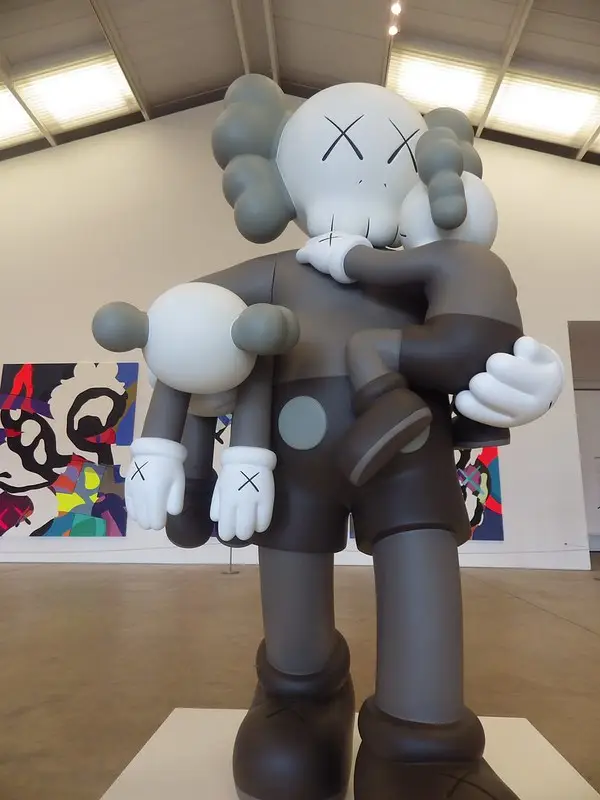
Source: https://flic.kr/p/EV4k29
Beyond these, KAWS has also reinterpreted other cultural icons. For instance, he’s done his own take on Snoopy from Peanuts and even SpongeBob SquarePants, blending these familiar figures with his distinct style. By reimagining these characters, KAWS taps into the universal language of popular culture, making his work accessible and relatable across different audiences.
KAWS’s Transition from Graffiti to Fine Art
In the early years of his career, KAWS made his mark as a graffiti artist, tagging various surfaces around New York. One of his signatures was to “deface” advertisements in bus shelters, subtly altering them with his designs. This approach wasn’t just about shock value but about bringing his art into public spaces and transforming commercial imagery into something more personal and reflective.
From these beginnings, KAWS’s work evolved, and he took on more ambitious projects that pushed him into the gallery scene. His big break came in Japan in 2001 with the launch of his label, OriginalFake, which allowed him to make and sell high-quality vinyl toys of his characters. The popularity of these toys among fans worldwide solidified his position as an artist who bridges the gap between fine art and consumer products.
A Look at His Most Famous Sculptures
KAWS has a unique talent for creating instantly recognizable and deeply expressive sculptures. His large-scale pieces, often featured in public spaces, are inspired by his own characters. For example, you’ll find oversized versions of Companion in cities worldwide, towering over viewers and providing a larger-than-life presence.
One of his most notable installations, a 40-foot-long reclining Companion, floated in Hong Kong’s Victoria Harbour. These sculptures capture the same blend of playfulness and introspection found in his two-dimensional works, bringing a larger-than-life experience to his audiences. The detailed lines, proportions, and attention to texture are characteristic of KAWS’s precise style, making these sculptures both monumental and intimate in feel.
The Artistic Themes Behind KAWS’s Work
While KAWS’s art looks playful and simple at first glance, it carries a sense of nostalgia, longing, and sometimes critique. His use of X-eyes and skeletal elements hints at themes of alienation, loneliness, and the impact of commercialism on our lives. Through characters that are both familiar and altered, he reflects on how we relate to commercialized imagery and how personal identity interacts with mass media.

Source: Leo Lambertini, Attribution-NoDerivs (CC BY-ND 2.0), https://flic.kr/p/e2U2A9
For example, in pieces featuring characters with exaggerated, rounded features and oversized hands, there’s a subtle commentary on how consumer culture shapes our perception of comfort and belonging. These works invite viewers to question what’s authentic and what’s commercial — a question KAWS explores by pulling imagery from icons we all recognize.
KAWS Beyond the Gallery: Collaborations and Influence
KAWS’s collaborations with brands have brought his work to a new level of visibility. Through partnerships with companies like Nike, Uniqlo, and Dior, his art has reached people who may not typically engage with contemporary art. His Uniqlo T-shirts featuring characters like Companion sold out worldwide, becoming coveted items that blend fashion with art. These collaborations highlight his ability to merge art with the commercial world without losing the depth of his message.
His influence can be seen in how other artists and designers approach art in public spaces and product design. By fusing the worlds of commercial art and fine art, KAWS has paved the way for new generations to see art as something that can exist in both high and low spaces, accessible to a wide range of audiences.
Why KAWS Matters Today
KAWS’s work has done something unique in the art world: it has taken the elements of street art and commercial iconography and elevated them into the realm of fine art. His pieces resonate with a broad audience, drawing in everyone from children who love his playful characters to serious art collectors. KAWS’s ability to make art that’s approachable yet complex has positioned him as a key figure in contemporary art.
In a way, KAWS has created a new kind of pop art. While artists like Andy Warhol critiqued consumer culture by reproducing icons, KAWS went further by transforming these icons into his own characters with personality, expression, and even vulnerability. His work speaks to our shared cultural experiences, blending personal emotion with the omnipresence of commercial culture. Through KAWS, art and popular culture continue to mix, creating something refreshingly original and universally relatable.
Whether you see his work in a gallery or on a T-shirt, KAWS has made contemporary art an accessible and engaging part of everyday life, reminding us that art can be as much a part of our world as the commercial images we see every day.
Featured image: Leo Lambertini, Kaws Lightbulb Attribution-NoDerivs (CC BY-ND 2.0), https://flic.kr/p/9iubS7