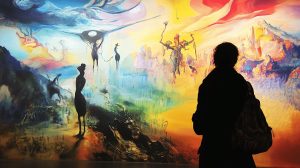
Abstract Expressionism is an art movement that redefined the landscape of modern art in the mid-20th century. Emerging in the post-World War II era, this movement was deeply influenced by the political and cultural shifts of its time. Characterized by large-scale, emotionally charged works, Abstract Expressionism focuses on conveying deep emotions and exploring the subconscious through abstraction.
Origins and Influences of Abstract Expressionism
The term “Abstract Expressionism” first surfaced in the 1940s, though its roots go back further. It combines the intensity of German Expressionism with the non-figurative forms of movements like Surrealism, Cubism, and Futurism. The name was first applied to American art by critic Robert Coates in 1946, who used it to describe the work of artists like Jackson Pollock, Willem de Kooning, and Arshile Gorky.
European Modernist influences played a key role in shaping Abstract Expressionism. Many European artists fled to the United States during World War II, bringing avant-garde ideas with them. This influx of creative talent helped American artists like Pollock, de Kooning, and Rothko find new ways to explore themes of human existence, consciousness, and emotion. Hans Hofmann, a German artist who became a leading figure in American Modernism, was especially influential in blending European techniques with American sensibilities.
The Key Characteristics of Abstract Expressionism
At its core, Abstract Expressionism emphasizes spontaneity, raw emotion, and freedom of expression. While the movement is united by these themes, the styles of its artists vary significantly.
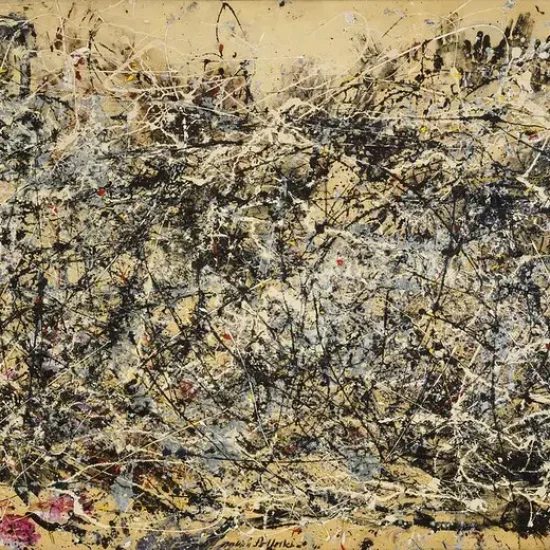
- Action Painting: One of the defining techniques of Abstract Expressionism, action painting was popularized by Jackson Pollock. In this style, paint is dripped or splattered onto the canvas, with the artist physically engaging with the work to create a sense of dynamic movement. Pollock’s method of laying the canvas on the floor and moving around it, flinging paint with brushes or sticks, brought a visceral energy to his work.
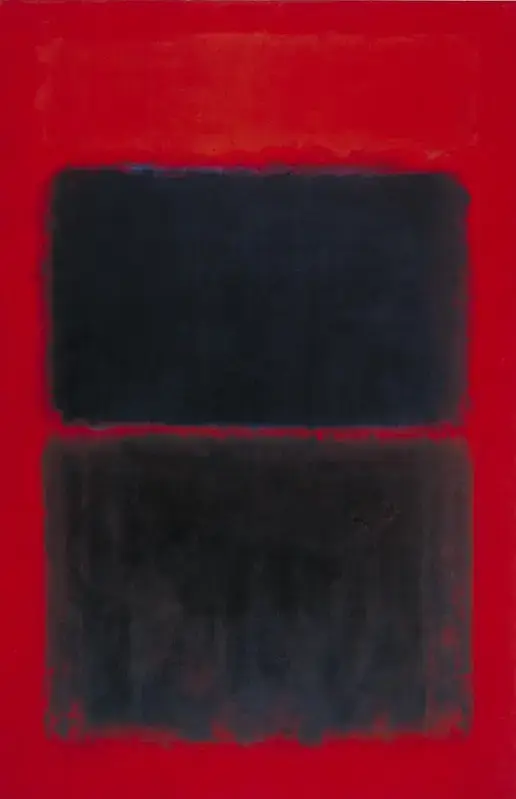
- Color Field Painting: In contrast to the aggressive energy of action painting, Color Field artists like Mark Rothko and Barnett Newman focused on large areas of color, applied in soft, hazy rectangles. These works were intended to evoke deep emotional responses and create contemplative spaces where the viewer could experience the subtle interaction of colors.
Both techniques aim to express emotion without relying on representational forms. Instead, artists use color, shape, and texture to explore themes of existentialism, human suffering, and the complexities of the unconscious mind.
Prominent Artists and Works
Several artists are considered pioneers of Abstract Expressionism, each contributing uniquely to the movement.
- Jackson Pollock: Known for his action paintings, Pollock revolutionized the way artists approach the canvas. His famous drip paintings, such as No. 5 (1948), demonstrate his signature technique of pouring and splattering paint in energetic, chaotic patterns.
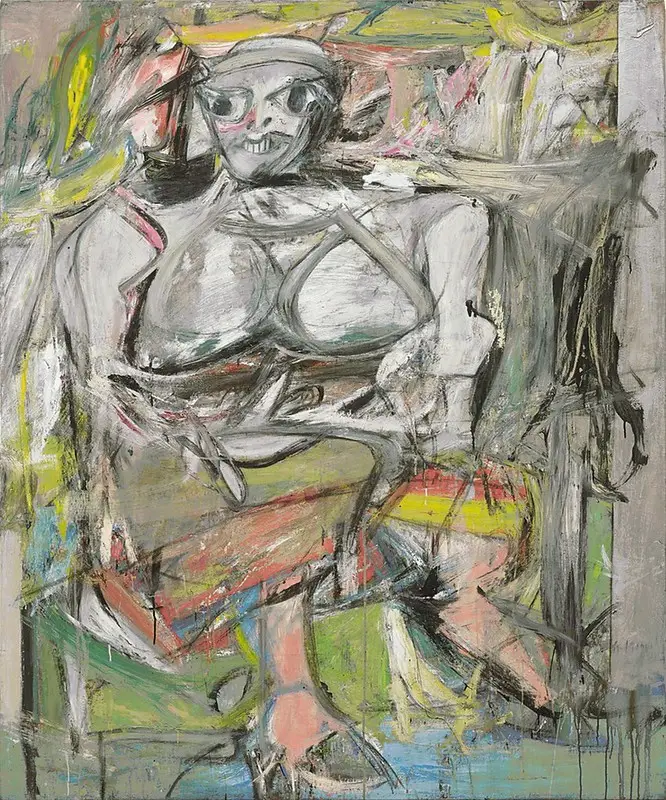
- Willem de Kooning: A central figure in the movement, de Kooning often blended abstraction with figuration. His Woman series, especially Woman I (1952), shows a combination of bold, aggressive brushstrokes and distorted figures, exploring complex emotions related to the human form.
- Mark Rothko: Rothko’s Color Field paintings, such as No. 61 (Rust and Blue) (1953), consist of soft-edged blocks of color that seem to float on the canvas. His work was less about technique and more about the emotional experience of color, aiming to evoke a meditative state in viewers.
- Franz Kline: Kline’s bold black-and-white abstractions, like Chief (1950), demonstrate the power of simplicity and gesture. His work often feels spontaneous, though Kline meticulously planned his compositions.
- Helen Frankenthaler: Frankenthaler pioneered the soak-stain technique, where she thinned paint to a watery consistency and allowed it to seep into unprimed canvas. This approach, seen in Mountains and Sea (1952), influenced the later Color Field painters and brought a lyrical quality to Abstract Expressionism.
Its Impact and Legacy
The rise of Abstract Expressionism coincided with America’s growing prominence in global culture after World War II. The movement symbolized freedom and individuality, making New York City the new center of the art world, a status previously held by Paris. It marked a shift from traditional European artistic dominance to an era where American art led the way in innovation.
The political climate of the time also played a role in the movement’s success. After the war, many artists sought to express the trauma and disillusionment of the era. Abstract Expressionism allowed them to process complex emotions through non-representational forms, creating an art that felt universal in its appeal. By focusing on abstraction, these artists avoided the constraints of political censorship and were free to explore existential and philosophical themes.
Lasting Influence
Abstract Expressionism paved the way for many subsequent movements, including Minimalism and Conceptual Art. Its emphasis on the artist’s process and the viewer’s emotional response changed the way people thought about art. Artists like Barnett Newman and Mark Rothko influenced Minimalist painters with their focus on simple forms and vast spaces. Meanwhile, the performative aspects of action painting laid the groundwork for later developments in performance art.
The movement’s legacy continues to influence contemporary artists, especially those who prioritize emotion, spontaneity, and abstraction. It also reshaped the art market, with works by Pollock, de Kooning, and Rothko fetching millions at auctions today. More importantly, it cemented the idea that art could be deeply personal yet resonate universally, a concept that continues to shape modern and contemporary art.
In conclusion, Abstract Expressionism was a transformative movement that redefined the boundaries of modern art. By emphasizing emotional expression, spontaneity, and abstraction, it allowed artists to explore the depths of the human experience in ways that continue to influence art today. Whether through the dynamic energy of Pollock’s action paintings or the contemplative stillness of Rothko’s Color Fields, Abstract Expressionism remains a powerful testament to the enduring power of artistic innovation.
Attribution:
Featured image: pieliny – Jackson Pollock Number 1A, 1948 – Attribution-NoDerivs (CC BY-ND 2.0) – https://flic.kr/p/aANYyM
Image 1: Steve Harlow – Willem De Kooning’s Woman I – Attribution (CC BY 2.0) – https://flic.kr/p/Wznoa2
Image 2: G. Starke – Mark Rothko, Light Red Over Black, 1957 – Attribution-ShareAlike (CC BY-SA 2.0) – https://flic.kr/p/269meY3