
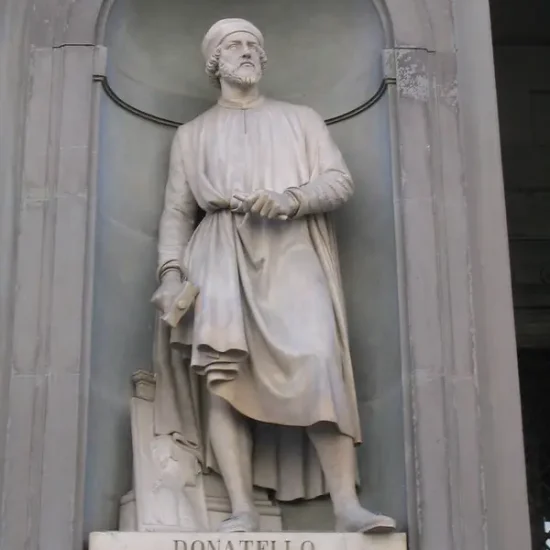
Donatello is one of the most influential artists of the early Renaissance, whose sculptures shaped the art world in ways that still resonate today. Born in Florence around 1386, Donatello worked alongside great artists like Brunelleschi and Masaccio, contributing to the cultural revolution in Italy. His mastery of sculpture brought a new sense of realism and emotion to figures, departing from the more rigid medieval style.
How Donatello Started His Career
Donatello’s full name was Donato di Niccolò di Betto Bardi, and he began his career as a goldsmith’s apprentice. His early training exposed him to a wide range of artistic techniques, setting the stage for his innovative approach to sculpture. By the early 1400s, he was working in Florence, a city at the heart of the Renaissance. Florence, with its thriving art scene, was the perfect place for an ambitious artist to push boundaries.
Donatello first made a name for himself by working on smaller, detailed sculptures, often religious in nature. As his reputation grew, he began receiving larger commissions from wealthy patrons, including the powerful Medici family, who played a significant role in the artist’s success.
A Breakthrough with David
Donatello’s “David” stands as one of his most famous works. But what’s particularly interesting is that he created not one, but two statues of David, each representing different stages in his artistic evolution. The first, carved in marble around 1409, shows the biblical hero as a youthful, almost serene figure. This marble David is more traditional in style, influenced by Gothic sculpture.
Source: Patrick – David by Donatello – Attribution-ShareAlike (CC BY-SA 2.0) – https://flic.kr/p/4n3t7A
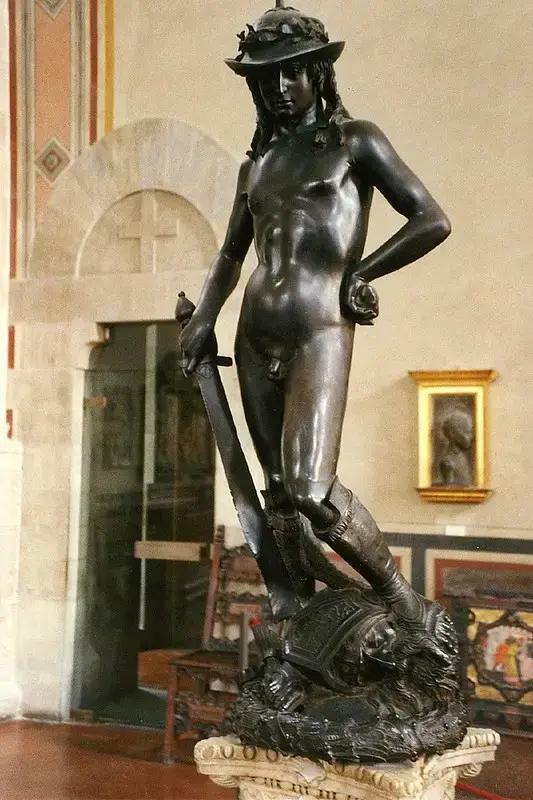
Fast forward to the 1440s, and Donatello crafted a bronze version of David, which is entirely different in tone and style. This bronze David is often considered the first free-standing nude statue since antiquity, marking a bold return to classical ideals. The figure, lightly clad in only a hat and sandals, stands victoriously over the head of Goliath. It’s not just David’s nudity that shocks but also the sensuality in the piece. Some scholars suggest that Donatello was making a statement about the beauty of the human form. However, others have speculated about deeper meanings relating to his personal life and Florentine culture at the time.
The bronze David is full of life and movement, capturing the moment just after the battle. The statue’s lightness and confidence set it apart from previous depictions of David, making it a defining piece of Renaissance art. For many, this work encapsulates the period’s celebration of human achievement and beauty
Artistic Innovations By Donatello
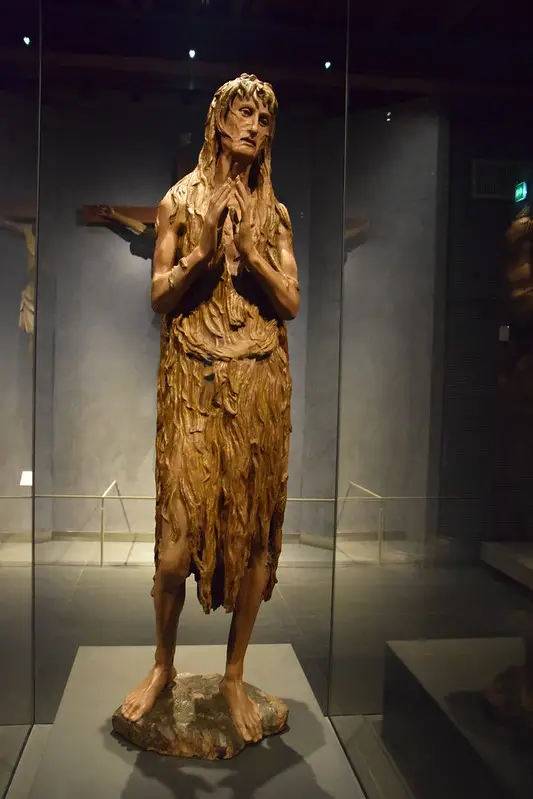
One of Donatello’s most important contributions to Renaissance art is his ability to convey emotion through sculpture. His figures are not just lifelike in appearance; they also express complex feelings. For instance, his statue of Mary Magdalene, carved in wood, departs from the idealized beauty of many religious figures. Here, Donatello presents her in a raw, vulnerable state, emaciated and worn from years of penance. The emotional weight of the piece reflects Donatello’s deep understanding of human suffering and redemption.
Source: George M. Groutas – Penitent Magdalene (Donatello) – Attribution (CC BY 2.0) – https://flic.kr/p/2gsf2EH
Similarly, his Equestrian Statue of Gattamelata, created in the 1450s, demonstrates his technical prowess. This statue, showing the Venetian general Erasmo da Narni (known as Gattamelata) on horseback, is one of the earliest large-scale equestrian statues since the Roman Empire. Its scale and balance are remarkable, with both horse and rider depicted in lifelike detail. The general’s face is stern, exuding power and control, while the horse is shown in mid-stride, adding a sense of movement to the piece.
Another notable technique Donatello helped to develop is Stiacciato, a type of low relief that uses subtle gradations in depth to create a more realistic sense of space. His St. George and the Dragon relief is a prime example, with figures that seem to emerge from the stone, creating a sense of depth without resorting to heavy carving.
A Legacy of Innovation
By the time Donatello passed away in 1466, he had revolutionized sculpture in ways that influenced not just his contemporaries but also later artists like Michelangelo. His ability to balance realism with idealism made his figures seem alive, bridging the gap between the classical world and the modern age. He broke away from the static, stiff figures of the Gothic era, imbuing his subjects with emotion, movement, and individuality.
Throughout his life, Donatello worked in a variety of mediums—bronze, marble, wood, and terracotta—each of which he handled with skill and innovation. His bronze pieces, like Judith and Holofernes, are characterized by their dynamism and drama, while his marble works often capture more delicate, introspective moments.
As an artist, Donatello was not content simply repeating the styles of the past. Instead, he was constantly experimenting, whether through new materials, like his use of bronze, or by pushing the boundaries of what sculpture could convey. His works range from the graceful to the gritty, each offering a new take on traditional religious and historical subjects.
Conclusion
Donatello’s art reflects the spirit of the Renaissance, a time when artists were rediscovering the potential of human creativity. His innovations in sculpture, especially in his portrayals of the human form, changed how artists approached their subjects. His works are still celebrated today, not just for their technical brilliance, but for their ability to communicate something deeply human. Through his figures, Donatello captured the complexity of life, full of triumphs, struggles, and emotion, leaving behind a legacy that continues to inspire.
Featured image: Andrew Demey – Donatello – Attribution-ShareAlike (CC BY-SA 2.0) – https://flic.kr/p/gT47S