

Greek statues have long been celebrated for their artistry, craftsmanship, and the stories they tell. These works of art go beyond mere decoration, capturing ideals of beauty, movement, and human nature that still resonate today. Let’s explore their origins, styles, and significance.
The Origin of Greek Statues
Greek sculpture dates back to the Archaic period (around 800–500 BCE). During this time, statues were heavily influenced by Egyptian art, with rigid, formal poses and stylized features. Think of the kouros (youthful male figures) and kore (clothed female figures). These statues often served as grave markers or offerings to gods, reflecting a spiritual connection rather than realism. While they weren’t as lifelike as later works, they laid the groundwork for what was to come.
By the time the Classical period rolled around (around 500–323 BCE), Greek sculptors were pushing boundaries. Artists began to focus on realism, studying anatomy to better capture the natural movements of the human body. Myron’s Discobolus (the Discus Thrower) is a perfect example of this shift. Sculptors also started exploring emotions and expressions, giving their work a sense of life and humanity.
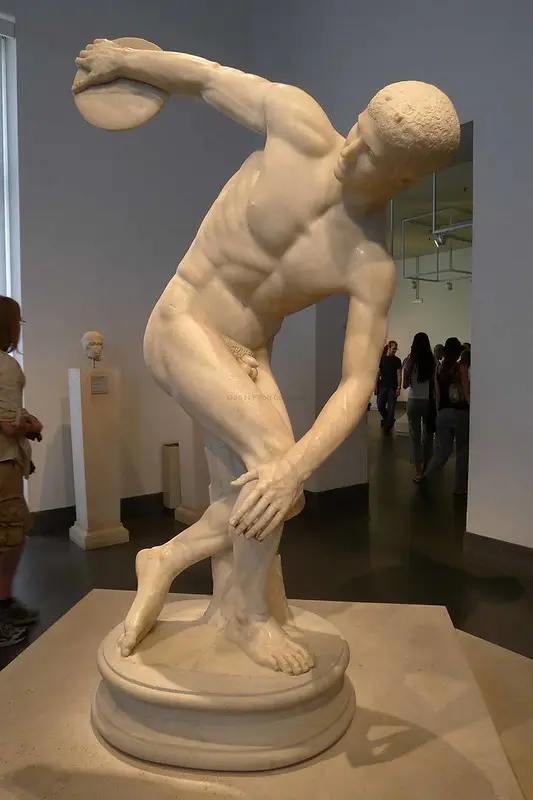
Source: elliottgoodman, Attribution-NoDerivs (CC BY-ND 2.0), https://flic.kr/p/aNwVrr
Polishing Perfection in the Classical Era
The Classical era marked a high point in Greek sculpture. During this period, artists like Polykleitos and Phidias developed new approaches to their craft. Polykleitos even wrote a guide, the Canon, detailing the ideal proportions for the human body. This wasn’t just about aesthetics; for the Greeks, physical beauty was tied to moral virtue and the concept of kalokagathia, which emphasized harmony between body and character.
Phidias, on the other hand, became famous for monumental works like the statues of Athena in the Parthenon. His creations weren’t just technically brilliant but also deeply symbolic, embodying Greek ideals of strength, wisdom, and divinity.
What’s striking is how these sculptures balanced naturalism with idealism. They weren’t meant to be exact replicas of people but rather representations of how humans should look—strong, youthful, and flawless.
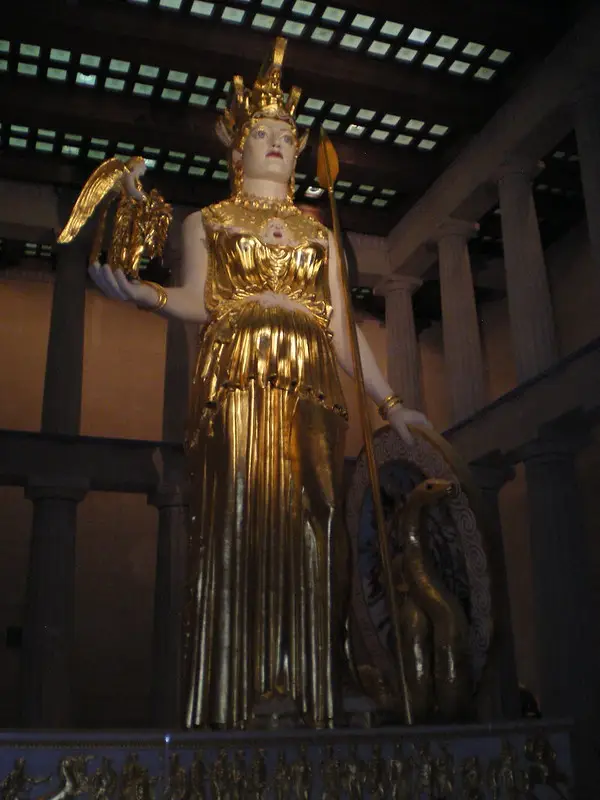
Source: Celeste Lindell, Statue of Athena, Attribution (CC BY 2.0), https://flic.kr/p/6qAL6s
The Hellenistic Twist
The Hellenistic period (323–31 BCE) took everything a step further. While earlier statues aimed for balance and restraint, Hellenistic art embraced drama, movement, and emotion. Think of the famous Laocoön and His Sons, which captures raw agony as the figures struggle against serpents. Sculptors were no longer content with perfection; they wanted to show the depth and complexity of human experience.
This era also brought more diversity. Statues began depicting children, the elderly, and even non-Greek subjects, reflecting a broader, more inclusive vision of humanity. The realism reached such heights that you could almost feel the tension in their muscles or the softness of their skin.
Greek Statues had Color?
It’s easy to imagine Greek statues as pristine white marble, but that’s far from the truth. Most of them were originally painted in vibrant colors—a practice known as polychromy. These details, from clothing patterns to realistic skin tones, added another layer of life to the sculptures. Over time, the paint faded, leaving behind the stark white surfaces we associate with Greek art today. Modern technology has helped uncover these hidden hues, reminding us just how dynamic these works once were.
Materials and Techniques
Greek sculptors primarily used marble and bronze, each offering unique challenges and rewards. Marble was prized for its durability and luminous quality, while bronze allowed for more dynamic poses thanks to its strength. Bronze sculptures were often created using the lost-wax casting technique, a method so intricate that it’s still admired by modern artisans.
Unfortunately, many bronze works were melted down over the centuries, leaving us with only Roman copies in marble. Still, these replicas give us a glimpse into the artistry of the originals.
Beyond the Aesthetics
Greek statues weren’t just about beauty—they played a vital role in society. Many were religious, portraying gods and goddesses in a way that made them approachable yet awe-inspiring. Others commemorated victories or honored individuals, blending public celebration with personal storytelling.
The underlying philosophy was that art could educate and inspire. By depicting the ideal human form, Greek sculptors encouraged people to strive for their own versions of excellence, both physically and morally. It wasn’t just about looking good; it was about living well.
The Impact of Greek Statues on Our World
Greek statues have influenced art and culture for centuries. Their focus on proportion, movement, and expression laid the foundation for Western art, inspiring countless artists from the Renaissance to today. Even now, they remind us of humanity’s potential, capturing timeless ideals that transcend eras.
These sculptures are more than just relics; they’re a testament to creativity, innovation, and the enduring power of art. Whether it’s the serene face of a kore or the dramatic tension of a Hellenistic masterpiece, Greek statues continue to captivate and inspire us. They’re a window into a world that valued beauty, balance, and the pursuit of greatness.
Featured image: https://unsplash.com/photos/a-statue-of-a-woman-wearing-a-necklace-1IoAtgEn7Hg