How Man Ray Began His Career
Man Ray, born Emmanuel Radnitzky in 1890, wasn’t someone who followed the typical path in life. Growing up in Philadelphia and later moving to Brooklyn, he began as a painter. But unlike most artists at the time, he didn’t restrict himself to one form. His vision went beyond the canvas and into a mix of media that many hadn’t considered “art” before. Painting, photography, film, sculpture—you name it, he tried it.
In the 1920s, he made a move that would change everything: he headed to Paris. There, he joined the ranks of artists experimenting with surrealism and Dadaism, two artistic movements that broke the mold. With these, he found a new playground for his creativity, where convention didn’t matter, and rebellion was the name of the game. He quickly became known for his unconventional approach, working with experimental techniques that blurred the lines between photography and painting.
The Art of “Rayographs”
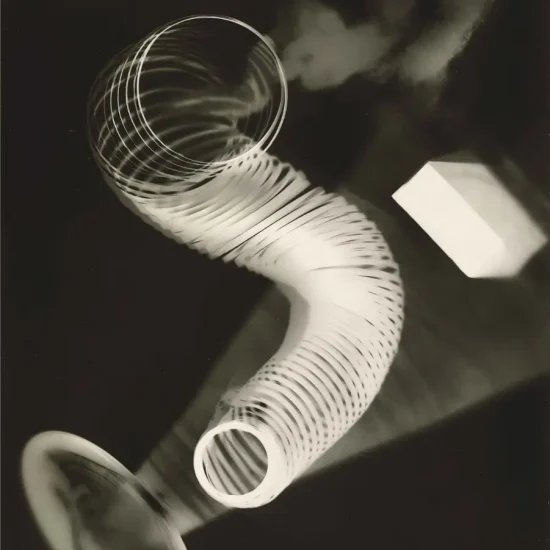
In Paris, Man Ray stumbled upon something revolutionary. Accidentally, he discovered a technique he called “rayographs” (a clever play on his own name). By placing objects directly onto photographic paper and exposing them to light, he created ghostly images that looked almost otherworldly. These photos were dreamlike impressions, full of shadow and light, that captured an abstract form rather than a clear-cut reality. No camera involved. Just light and objects.
It’s not hard to see why people were fascinated. Rayographs turned everyday items into mysterious, almost supernatural shapes and forms. For example, a simple comb or a pair of scissors would emerge on the paper looking like something straight out of a dream. This method let Man Ray experiment endlessly and gave him a signature style that few others could match. Rayographs became one of the trademarks of his work and solidified his place in art history as a pioneer of photographic art.
Man Ray Moves Towards Surrealism
Man Ray didn’t stop at rayographs. He also took on portrait photography with an innovative eye, creating images that looked like they belonged in a surrealist painting rather than a family album. He photographed some of the biggest cultural icons of his time—think Pablo Picasso, James Joyce, and Gertrude Stein—and made each portrait as distinct as the person it captured.
What made his portraits stand out was his ability to bring an unusual twist to them. He’d play with lighting, angles, and props to create a mood that was striking and sometimes unsettling. For example, in his photograph “Le Violon d’Ingres,” Man Ray took a picture of his muse, Kiki de Montparnasse, with two f-holes (like those on a violin) painted on her back, making her body look like a musical instrument. It’s an image that’s both beautiful and strange—just the kind of balance he loved.
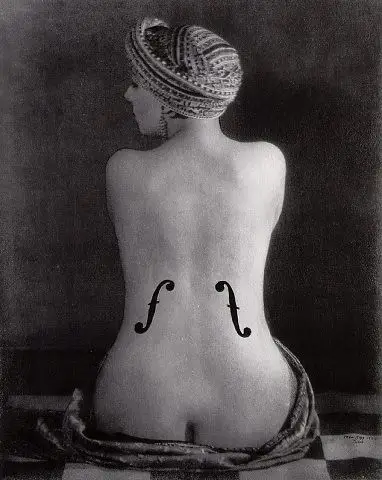
Source: Haka004, Man Ray, Le violon d’Ingres, Attribution (CC BY 2.0), https://flic.kr/p/9qyAMD
Breaking Boundaries with Film
Photography and painting weren’t enough for Man Ray, though. In the 1920s, he dabbled in filmmaking, a medium that was still new and full of possibilities. His films like Emak Bakia and L’Étoile de Mer reflected the same surreal and avant-garde style as his other works. With these films, he continued his experiments in light, shadow, and movement, creating sequences that defied conventional storytelling.
Film allowed him to explore time and movement in a way that still photography couldn’t. He layered frames, used double exposures, and created visuals that seemed to defy logic, which aligned perfectly with the surrealist ideas he embraced. For audiences used to straightforward narratives, his films were confusing yet fascinating, as they hinted at meaning without handing it over too easily.
Fashion Photography: Turning Heads in Vogue
Man Ray’s reach wasn’t limited to the art world; he made a mark in fashion too. When he began working with Vogue magazine in the 1930s, he brought his surrealist touch to fashion photography, a field that often played it safe. For Man Ray, fashion shoots weren’t just about showing clothes. They were about telling a story, about using light, shadow, and imagination to turn a simple model into something unforgettable.
His work in fashion pushed boundaries, giving life to photographs that felt fresh and bold. He wasn’t afraid to blur or distort parts of the image or use shadows to create unique effects. In doing so, he transformed fashion photography into an art form, proving that even commercial work could be creative and boundary-pushing.
Later Years and Lasting Legacy
When World War II erupted, Man Ray returned to the U.S., settling in Los Angeles. Though he left behind the buzzing Paris art scene, he didn’t stop creating. He continued to paint, photograph, and experiment in his own way. Eventually, he returned to Paris, where he lived until his passing in 1976. By that time, he had left behind a body of work that spanned nearly every medium and genre.
Today, Man Ray is remembered as one of the most innovative artists of the 20th century. His work is displayed in museums worldwide, and his influence can be seen in both fine art and popular media. His methods, like the rayographs and his surrealist portraits, still inspire photographers and artists. The way he brought a painterly touch to photography and a photographic sensibility to painting set him apart from the crowd. He didn’t just blur the lines between genres; he erased them.
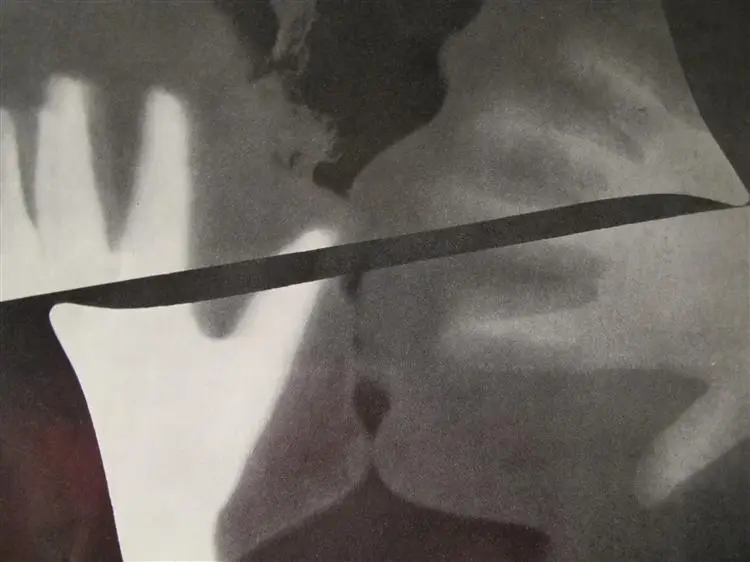
Source: https://www.wikiart.org/en/man-ray/rayograph-the-kiss-1922
Why Man Ray Still Matters
What makes Man Ray’s work so interesting is how it speaks to the value of experimentation and play in art. He didn’t care much for labels or artistic boundaries, and his work shows what can happen when an artist follows curiosity over convention. Whether it’s a shadowy rayograph or a surreal portrait, his pieces have a way of inviting viewers to look closer, to find beauty in the unexpected.
In a way, Man Ray showed that art could be anything: a photograph, a shadow, a film frame, or an object that you wouldn’t normally look at twice. By constantly exploring and challenging himself, he set a new standard for what art could be. And that’s a legacy that, much like his work, has a timeless, mysterious quality—something you can’t quite put your finger on but that sticks with you long after.