
Pop art emerged in the 1950s and 60s as a reaction against traditional fine art and the more abstract movements that had dominated the previous decades, like Abstract Expressionism. Rather than focusing on the deep emotional or existential themes central to earlier art movements, pop art embraced the imagery of everyday life. Advertising, comics, and consumer products were its subjects, presented in bright, bold colors and with a sense of irony that felt fresh and subversive.
The Origins of Pop Art
The roots of pop art trace back to Britain in the 1950s, when artists like Eduardo Paolozzi and Richard Hamilton began experimenting with collage and other techniques to critique the growing influence of American consumer culture. In fact, Hamilton’s iconic collage Just What Is It That Makes Today’s Homes So Different, So Appealing? is often cited as one of the first true pop art pieces, featuring a bizarre yet striking mix of bodybuilders, vacuum cleaners, and canned ham, which reflected the material excess of post-war America.
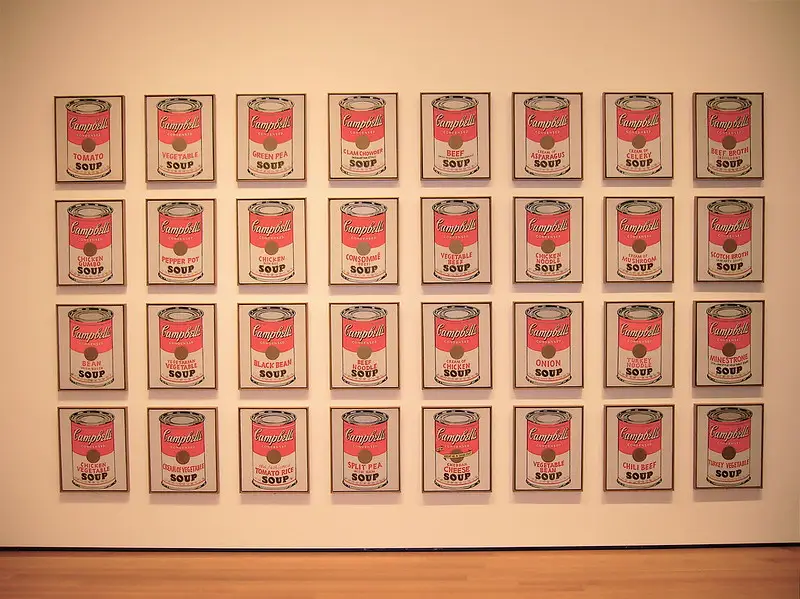
In the U.S., pop art exploded in the early 1960s, largely thanks to the efforts of artists like Andy Warhol, Roy Lichtenstein, and Claes Oldenburg. These artists, in particular, took elements from advertising, cartoons, and mass media, reinterpreting them in critical and celebratory ways. Warhol’s famous series of Campbell’s Soup cans is perhaps the best-known example. By treating a humble can of soup as an object worthy of artistic reverence, Warhol blurred the lines between high art and commercialism.
Warhol, Lichtenstein, and the Icons of Pop Art
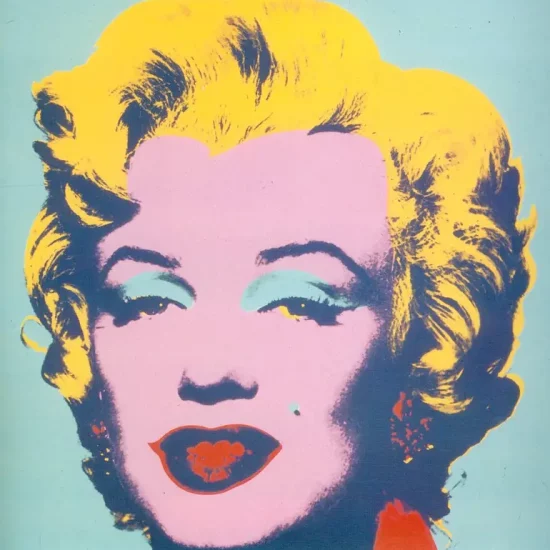
Andy Warhol is undoubtedly the face of the pop art movement. His obsession with celebrity culture, mass production, and consumerism was central to his work. In pieces like Marilyn Diptych and his screen prints of soup cans and Coca-Cola bottles, Warhol brought mass culture into the art gallery, challenging the idea that art had to be about deep or lofty themes. By mimicking the style and techniques of advertising, Warhol removed any personal or emotional elements from his work, pushing instead for a detached, machine-like precision. In many ways, Warhol’s art was a direct reflection of the increasingly commercialized world he saw around him.
Roy Lichtenstein, another key figure in pop art, took a slightly different approach. Rather than focusing on commercial goods, Lichtenstein drew heavily from comic books. His works often featured dramatic, emotional scenes taken directly from comic panels but blown up to monumental sizes. Pieces like Drowning Girl use the visual language of comics—simple lines, bold colors, and thought bubbles—but strip them of their original context. Lichtenstein’s use of Ben-Day dots, a printing technique commonly found in comic books, was a signature aspect of his style, and it further emphasized the mechanical, impersonal quality of pop art.

Claes Oldenburg also made a name for himself within the pop art movement, but his focus was on sculpture. Oldenburg’s large-scale replicas of everyday objects, like hamburgers or lipsticks, offered a playful commentary on consumerism. His work was both humorous and thought-provoking, questioning the value we place on objects in a consumer-driven society.
The Influence of Advertising and Mass Media
Pop art was deeply intertwined with the rise of mass media. Television, magazines, and advertising were becoming ubiquitous in the mid-20th century, and pop artists took full advantage of this. They didn’t just observe these cultural changes; they actively participated in them. Warhol famously declared, “I want to be a machine,” and his approach to art often mimicked the repetitive, mass-production techniques used by advertisers. This was art for a new, fast-paced, media-saturated world, where images were consumed quickly and constantly.
James Rosenquist, another significant pop artist, began his career as a billboard painter. His experience in this field heavily influenced his large-scale works that combined images of political figures, consumer goods, and mass media imagery. In President Elect, for example, Rosenquist juxtaposed John F. Kennedy’s face with images of a Chevrolet and a slice of cake, blending the realms of politics and consumerism in a way that felt deeply American.
Breaking Down the Barrier Between High and Low Art
One of pop art’s most significant contributions was its dismantling of the boundary between what was considered “high” and “low” art. Before pop art, the fine art world was largely separate from the everyday objects and images found in advertisements or comic books. Pop artists rejected this distinction. They believed that the mass-produced images of consumer culture were just as valid a subject for art as traditional themes like mythology or history.
By placing images of soup cans, comic book characters, and household objects in prestigious galleries, pop artists forced audiences to confront the ways in which their lives were shaped by mass culture. This was a radical departure from the more introspective and often difficult-to-understand art of previous movements.
Pop Art’s Legacy
The impact of pop art has been enormous. Its playful, ironic approach to consumer culture has influenced everything from advertising to fashion to contemporary art. Many of the ideas and techniques pioneered by pop artists continue to be relevant today, especially in an age where social media and digital culture dominate. Artists like Jeff Koons and Damien Hirst have built entire careers around concepts first explored by Warhol and his contemporaries.
At its core, pop art was about democratizing art. It brought art into the everyday world and made it accessible to everyone. Whether you loved it or hated it, pop art was impossible to ignore. Its bright colors, bold images, and clever use of irony continue to capture the imagination, long after the movement first took hold.
In the end, pop art wasn’t just a reflection of its time—it was a challenge to how we think about art and culture. And in that sense, its influence is still felt today.
Attribution:
Featured image: Ian Burt – Andy Warhol, Marilyn 1967 – Attribution (CC By 2.0) – https://flic.kr/p/9VmZt
Tim Pendemon – Drowning Girl by Roy Lichtenstein – Attribution (CC By 2.0) – https://flic.kr/p/dzkk8k
bfick – Andy Warhol’s Soup Cans – Attribution (CC By 2.0) – https://flic.kr/p/4cSNUF