

The Bauhaus Movement: A Fresh Vision in Art and Design
When you think of modern art and architecture, there’s a good chance the Bauhaus movement had a hand in shaping it. This innovative art school, founded in 1919 in Germany by architect Walter Gropius, didn’t just produce stylish furniture and buildings. It revolutionized the way people thought about art, design, and functionality. At a time when art was often seen as something ornamental, the Bauhaus took a more down-to-earth approach, believing that design should serve a purpose in everyday life.
The Origins of the Bauhaus Movement: Breaking Down Barriers
Gropius’ vision for Bauhaus was to dissolve the boundaries between artists and craftsmen. He saw an opportunity to merge art, technology, and everyday life, which meant blending architecture, graphic design, industrial design, and more. This was a pretty radical idea back then. Instead of separating different disciplines like most traditional art schools, Bauhaus encouraged students to learn a bit of everything. Gropius wanted artists and designers who could make buildings, furniture, and products with a clean, functional aesthetic, suited for the rapidly modernizing world.
This was a sharp shift from the ornate styles of the past. Instead of focusing on intricate details and decorations, Bauhaus’s design embraced simplicity, geometric shapes, and bold forms. This style made its way into everything the school produced—from furniture to buildings—and influenced design in countless ways.
A New Aesthetic: Minimalism and Function
The Bauhaus aesthetic became known for its minimalist, “less is more” style. The Bauhaus way emphasized clean lines, simple forms, and an absence of unnecessary details. In Bauhaus, everything needed a purpose. It wasn’t about looking pretty; it was about blending beauty with function.
One iconic example is the cantilever chair designed by Marcel Breuer, who was inspired by bicycle frames to use tubular steel, creating a chair that looked like it was floating. It was durable, lightweight, and practical—showing exactly what Bauhaus was all about. Breuer’s designs went on to influence everything from office furniture to home decor, and his ideas helped lay the foundation for modern furniture.
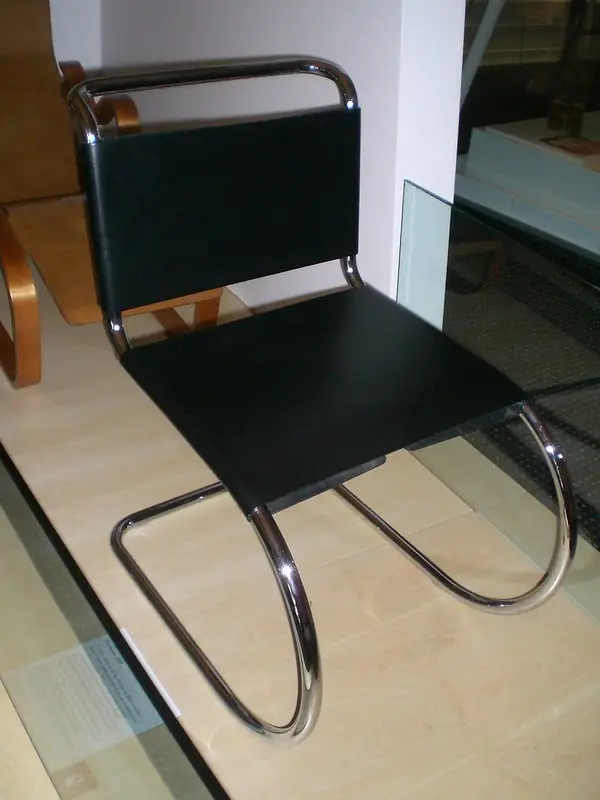
Source: BobMeade, MR Chair by Mies van der Rohe @ Powerhouse Museum, Attribution (CC BY 2.0), https://flic.kr/p/5pJAMn
Teaching at Bauhaus: A Hands-On Approach
At Bauhaus, education wasn’t about rigid theory; it was a hands-on experience. Students started with basic courses that covered materials, color theory, and form. From there, they’d move on to workshops where they could try out woodworking, metalworking, or textile arts. The school encouraged experimentation and creativity, giving students the freedom to learn through doing. This practical approach helped them become versatile creators who could work in a variety of fields.
The Move Toward Architecture
While the Bauhaus started with an emphasis on crafts and small-scale design, architecture soon became a central focus. Gropius believed that architecture was the ultimate art form, where all design principles could come together. In later years, Bauhaus architecture became known for its sleek, functional buildings with flat roofs, smooth facades, and large glass windows. These buildings were designed to be efficient, affordable, and visually striking.
One of the most famous examples of Bauhaus architecture is the school’s own building in Dessau, Germany. Designed by Gropius, it showcases many of the principles that Bauhaus held dear: an emphasis on function, a clean, unadorned look, and innovative use of materials. This “International Style” of architecture spread across the globe and influenced everything from skyscrapers in New York City to houses in California.

Source: gaku. , Bauhaus, Attribution (CC BY 2.0), https://flic.kr/p/itVk3
The End of the Bauhaus Movement
The Bauhaus movement didn’t last as long as its impact has. The school faced a lot of opposition from the start, especially as Germany’s political landscape shifted in the 1930s. Under pressure from the Nazi regime, which didn’t support Bauhaus’ progressive ideas, the school closed in 1933. But its ideas had already spread far and wide. Many Bauhaus teachers and students moved to other countries, taking their vision with them and spreading it to the U.S., the Soviet Union, and beyond.
In the years that followed, Bauhaus alumni became leaders in fields from industrial design to architecture. Designers like Ludwig Mies van der Rohe, another Bauhaus alum, went on to develop the “less is more” style that would become a hallmark of modern architecture. His sleek, glass-and-steel buildings are prime examples of Bauhaus principles in action.
The Influence of the Bauhaus Movement on Today’s Design
Even though it’s been a century since Bauhaus was founded, its influence is still everywhere. You can see it in IKEA furniture, with its simple, functional designs, or in urban apartments with open, light-filled spaces. The clean, functional aesthetic that Bauhaus championed has become so common that we sometimes don’t even realize it started as a radical idea.
Graphic design is another field that owes a lot to Bauhaus. The movement’s love for bold, simple shapes and typefaces gave rise to modern logo design, posters, and typography. Minimalist logos, functional layouts, and straightforward, readable fonts—all of these have Bauhaus roots.
In Conclusion: A Revolution in How We Live and Create
The Bauhaus movement may have been short-lived, but its impact is massive. By emphasizing simplicity, functionality, and the idea that “form follows function,” Bauhaus reshaped art, architecture, and design. It opened the door to modern styles that prioritize usability and practicality without sacrificing beauty. And while it started as an experimental school, its ideas have influenced everything from how we build our cities to the furniture we use in our homes.
In a way, Bauhaus brought art and design back to the basics, asking the question: How can we make things better for everyone? And even today, that question still resonates.