
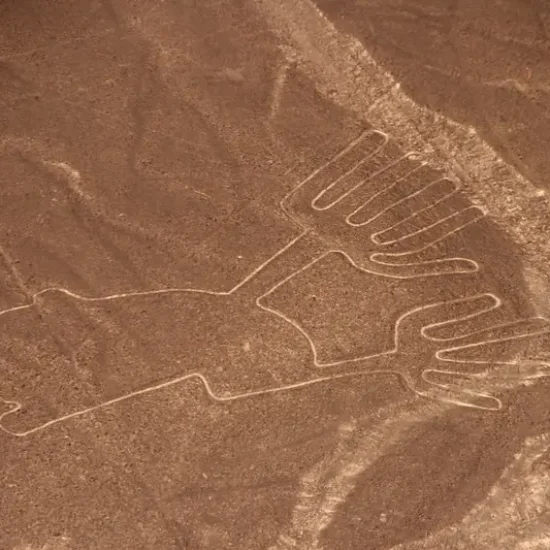
If you’ve ever heard of giant drawings sprawled across the desert in Peru, you’re probably familiar with the Nasca Lines. These massive geoglyphs are one of archaeology’s biggest mysteries. Covering over 200 square miles of the arid Nasca Desert, these designs include everything from geometric patterns to animals and even a humanoid figure. They’re big enough to be seen clearly from the sky, and despite being over a thousand years old, they’ve stood the test of time.
What Exactly Are the Nasca Lines?
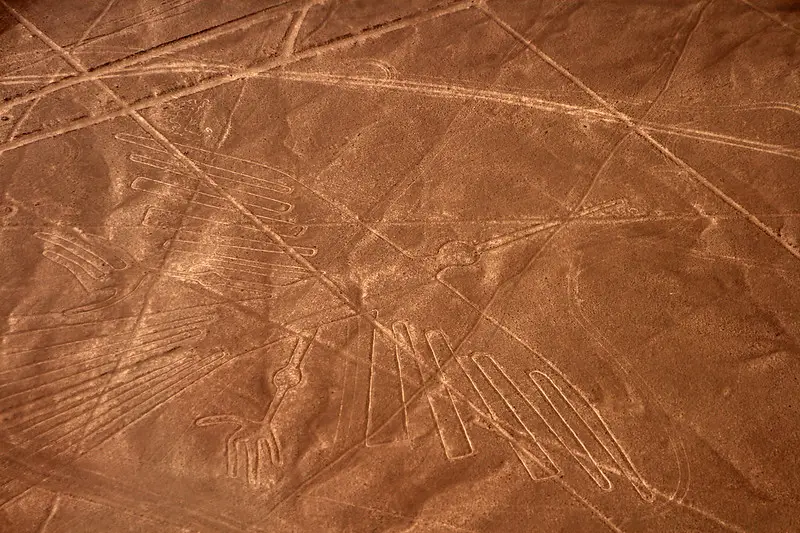
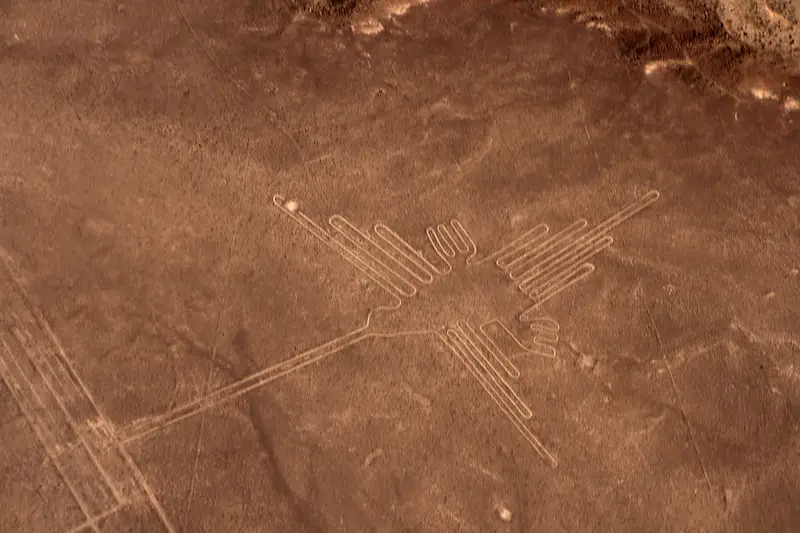
The Nasca Lines were created by removing the top layer of reddish-brown rocks to reveal the pale earth beneath. This process left behind sharply contrasting lines that form incredible shapes. Some designs are simple, like straight lines or spirals, while others are highly detailed. There’s a giant hummingbird, a monkey, a spider, and even a figure nicknamed “The Astronaut” because of its humanoid features.
Source: Christian Haugen, Attribution (CC BY 2.0), https://flic.kr/p/6z35fN
Most of the lines are so enormous that they’re only fully visible from above, which adds to the mystery. It wasn’t until planes started flying over the area in the 1920s that people realized how intricate and expansive these geoglyphs really are.
And Who Made The Nasca Lines?
The Nasca civilization, which thrived in the region between 500 BCE and 500 CE, is believed to be behind these lines. They were an innovative people, known for their advanced aqueducts that helped them survive in a harsh, dry environment. Their ability to create something as large-scale and precise as the Nasca Lines without modern technology speaks volumes about their ingenuity.
The tools used to create the lines were surprisingly simple. Wooden stakes and ropes have been found near some of the geoglyphs, suggesting that they used these tools to map out the shapes. For the more intricate designs, they might have started with smaller models, scaling them up with incredible accuracy.
Why Were They Made?
Here’s where things get interesting. The purpose of the Nasca Lines is still debated. Some researchers think the lines had astronomical significance, as certain patterns align with celestial events like solstices. Maybe they served as a kind of calendar or a way to track the seasons.
Another idea is that they were used for rituals related to water and agriculture. The Nasca lived in an arid environment, where rainfall was vital. The lines could have been offerings to deities to encourage rain or ensure fertile crops. This theory fits well with the Nasca’s strong connection to water, evidenced by their advanced irrigation systems.
There’s also a spiritual angle. The lines are close to Cahuachi, a ceremonial site that was a hub for religious gatherings. The site wasn’t residential—it was purely a place for rituals and offerings. Pottery found there features designs similar to those of the lines, which suggests the geoglyphs may have had a sacred purpose.
The Aerial Perspective
One of the most fascinating aspects of the Nasca Lines is their visibility from above. It’s easy to wonder why a culture without access to flight would create designs that can only be fully appreciated from the sky. This has sparked plenty of theories, some more grounded than others.
Source: Christian Haugen, Attribution (CC BY 2.0), https://flic.kr/p/6z3gH1
A few people have suggested extraterrestrial involvement—basically, the idea that the Nasca Lines were made as signals for aliens. While this theory is entertaining, it doesn’t hold much weight among archaeologists. The more likely explanation is that the Nasca understood how to view their work from surrounding hills or simply had the vision to create something monumental, even if they couldn’t see it in full.
Challenges of Preservation
The Nasca Lines have lasted for centuries, thanks to the desert’s dry, windless conditions. But they’re not immune to threats. Occasional flooding, human activity, and even vandalism have caused damage over the years.
Efforts to protect the lines ramped up after they were named a UNESCO World Heritage Site in 1994. There are strict regulations now to limit development and prevent further harm. Still, maintaining these ancient drawings in a modern world is an ongoing challenge.
A Glimpse Into the Past
The Nasca Lines aren’t just giant drawings in the sand—they’re a glimpse into the minds of the Nasca people. Whether they were used for religious rituals, astronomical tracking, or something we haven’t yet figured out, they show a level of creativity and ambition that’s hard to imagine today.
Standing near these geoglyphs—or seeing them from above—makes you think about the people who made them. What drove them to create such enormous designs? What did they see when they looked out at their work? While we might not have all the answers, the Nasca Lines remind us of humanity’s endless curiosity and creativity.
Featured image: Christian Haugen, Attribution (CC BY 2.0), https://flic.kr/p/6yYmiF